stuntman / plugins
A provider is a plugin. A plugin is a file.
Routes, the state they keep, the answers they give, the callbacks they send and the sentence each call leaves behind. Written once by someone who knows the provider; installed by everyone else.
Anatomy of a plugin.
service:
  name: recaptcha
  real_host: www.google.com
routes:
  - route: POST /recaptcha/api/siteverify
    receive:
      body: [secret, response]
    keep:
      state: tokens
      key: body.response
    decide:
      - when: body.response in state.tokens
        answer: duplicate
      - answer: human
answers:
  - name: duplicate
sentence: "Token used twice: timeout-or-duplicate"- service
- where it pretends to live, and the real host it stands in for
- routes
- one per kind of request; each reads receive → keep → decide → respond → send
- keep
- the state the provider remembers between calls
- decide
- plain expressions; the first match wins; no code
- answers
- the provider's bodies, and the sentence the timeline shows
More than request and answer.
The same file describes the parts of a provider that are hard to fake by hand. Details in docs/plugins.md.
| Feature | In the YAML | What it gives you |
|---|---|---|
| Regex and GraphQL routes | GET ~/v2/(?<id>[0-9]+) · graphql: CreateCharge | one route for a family of paths; one route per GraphQL operation |
| Streamed answers | stream: · stream_format: sse | ndjson | chunks | server-sent events and NDJSON, part by part; cut or slow on cue |
| Signed webhooks | service.webhooks.sign: stripe | svix | github | cloudevents | hex | hex_ts | callbacks your app must verify, broken on purpose when you ask |
| Idempotency keys | service.idempotency | a repeated key replays the first answer; another body gets 409 |
| Scenarios | when: scenario == 'gps_down' · scenario: | a provider that changes state, moved by a call or by set_scenario |
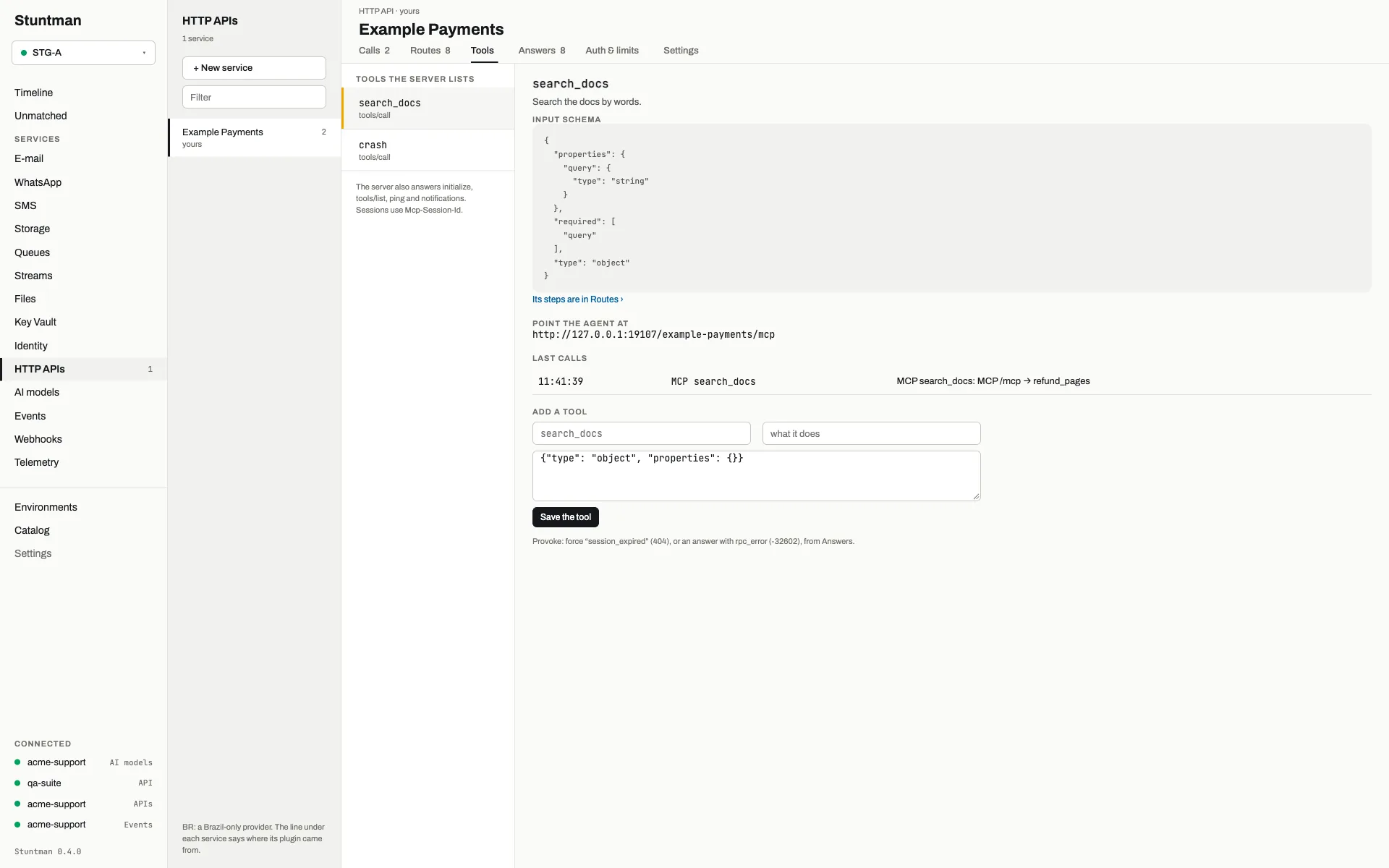
| An MCP server | mcp: · routes with tool: | a provider's own MCP tools, for apps that call them |
| WireMock templates | template: handlebars | imported mocks keep their {{request.path}} and {{now}} |
| The clock | send.delay: 30d · advance_clock | a renewal due in 30 days, sent now |
A provider that is an MCP server.
Declare mcp: and give routes a tool:. Your app's agent lists the tools, calls them, and gets the answers and failures you set, like any other route.
Or make it from what you have.
An OpenAPI spec or a WSDL
import_spec  service=acme-kyc
  source=https://api.example.com/openapi.json
WireMock mappings
import_mocks source=/mocks/partnersThe real sandbox
start_recording service=acme-kyc
  upstream=https://sandbox.example.com
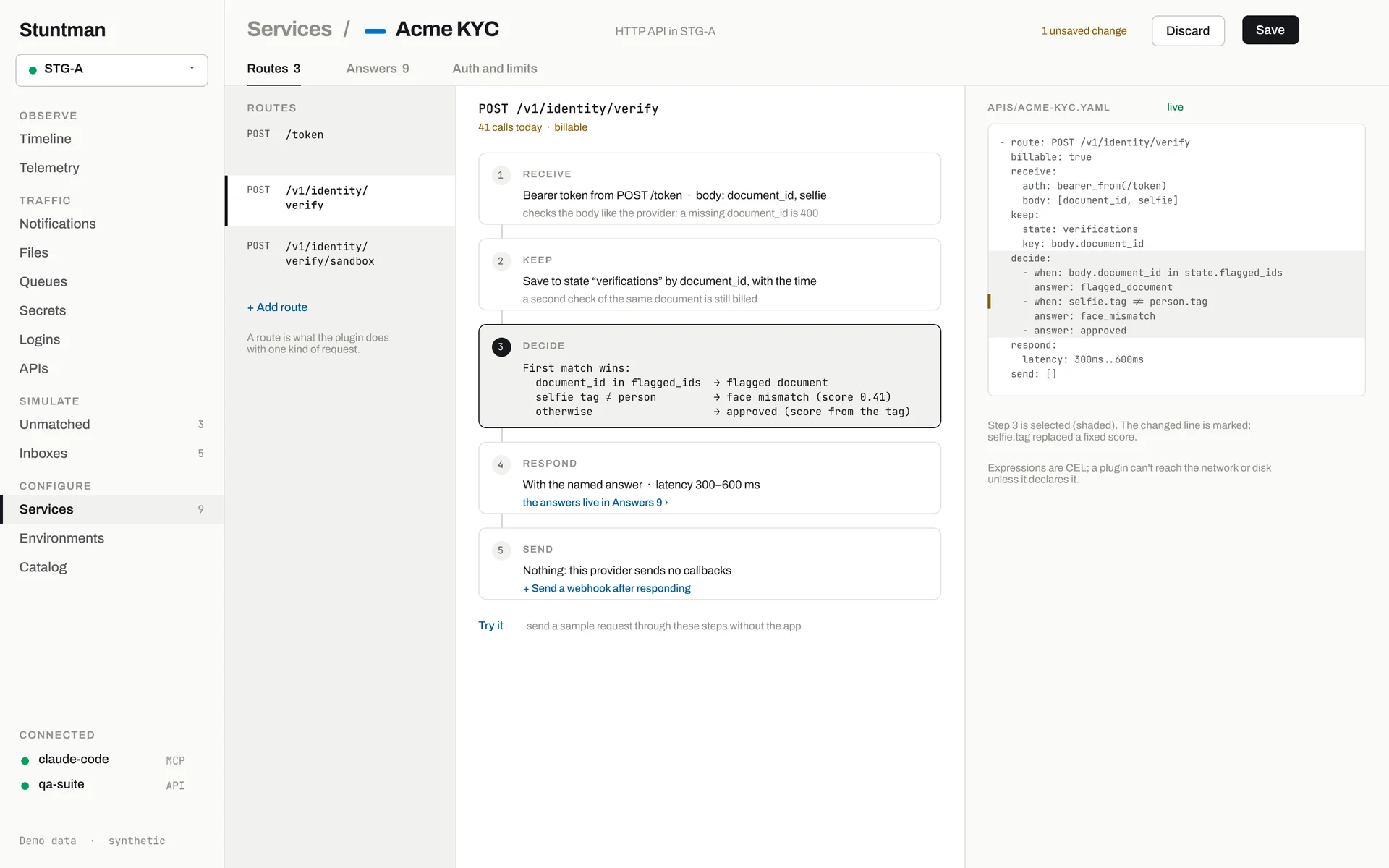
Edit in the UI. Keep the YAML.
The UI edits the same file. Every change is validated before it is saved, and the YAML beside the editor shows the exact lines that changed.
Install it three ways.
validate_plugin returns schema and expression errors with line numbers before anything is saved.
From the catalog
list_plugins
install_plugin recaptcha
From a folder or a .zip
import_plugin ./plugins/acme-kyc
install_import
From a git URL
import_plugin https://example.com/acme/plugins.git
  path=kyc ref=v1.2.0
Safe by default.
A plugin cannot reach the network or the disk unless it declares it. Expressions are a small, side-effect-free language.
Full format, expressions and contribution guide: docs/plugins.md. The catalog lives in engine/plugins.