stuntman / providers
Every provider your app calls. None of them real.
Each line is one kind of provider, such as SMS, storage or identity; a flavor or a plugin is one vendor's version of it. Stuntman answers like the provider, keeps its state and sends its callbacks back.
Every provider, in detail
What each stand-in does, its screens, what you can break and how your agent drives it.
- HTTP APIsAny REST, GraphQL or MCP API described once as a YAML plugin: routes, state, answers, callbacks and failures on cue.
- SOAPGive Stuntman the provider's WSDL and it answers like the SOAP endpoint: operations, XSD checks, faults, WS-Security and XML signatures.
- OpenAPIGive Stuntman the provider's OpenAPI or Swagger spec and it answers like the API: routes, answers, schema checks and the token route.
- RecordingNo spec and no plugin? Record the provider's sandbox through Stuntman and it writes the plugin for you.
- WireMock importTurn the WireMock mappings you already keep into plugins: paths, matchers, answers, delays, scenarios, templates and webhooks.
- AI modelsThe model APIs your app calls, answered without a model: rules shape the reply, failures come on cue, spend is counted.
- SMSA Zenvia SMS gateway that keeps every text, walks it through delivery steps and lets the person text back.
- WhatsAppMeta's WhatsApp Cloud API with templates, the 24-hour window, simulated people and signed webhooks.
- E-mailAn SMTP server and a SendGrid v3 API that catch every message, extract codes and links, and play the recipient.
- MailboxesIMAP and POP3 mailboxes your app reads: put a supplier's invoice in, and the app finds it on its next poll.
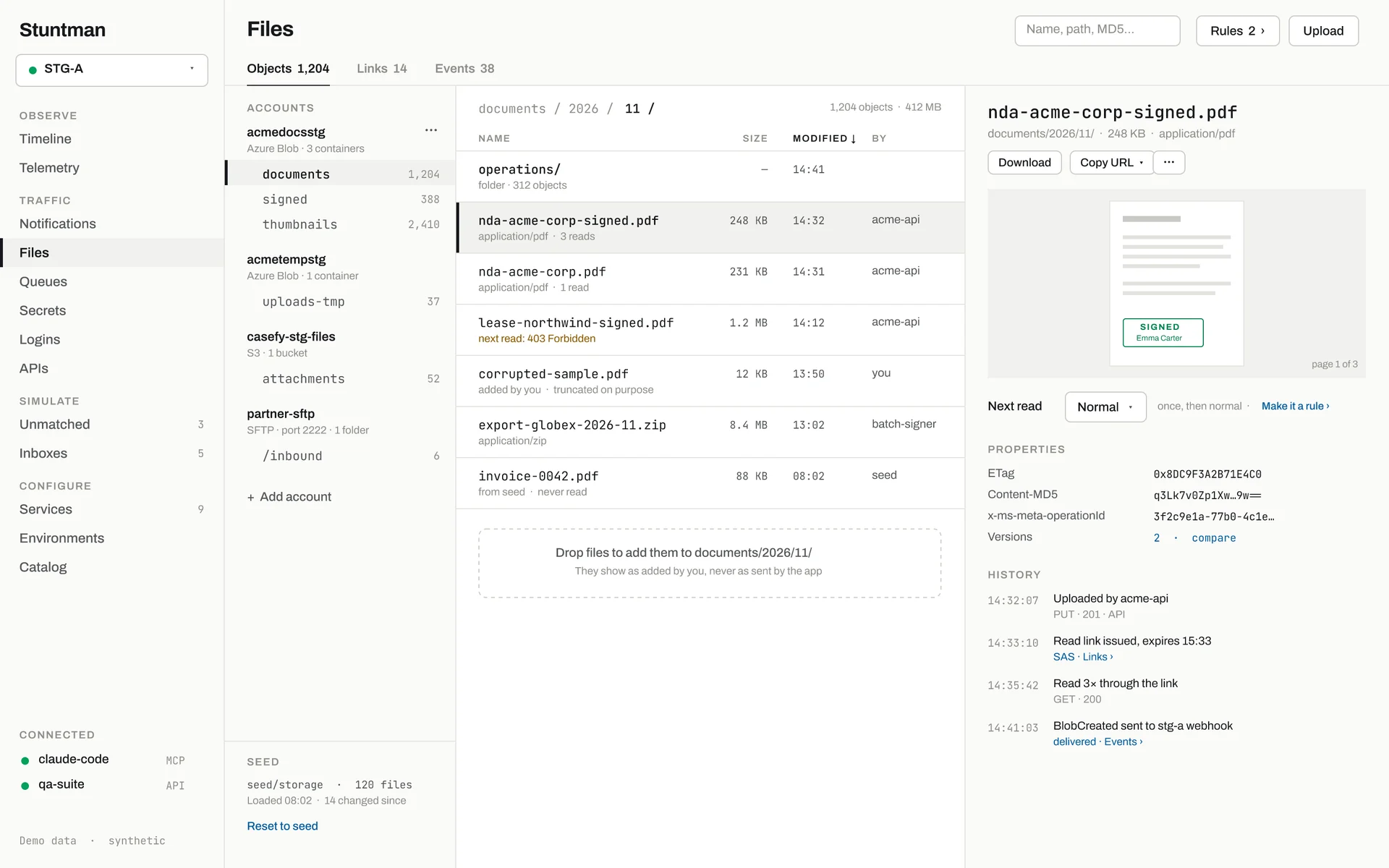
- StorageAzure Blob and Amazon S3 that keep every object, link and event, and fail exactly when you ask.
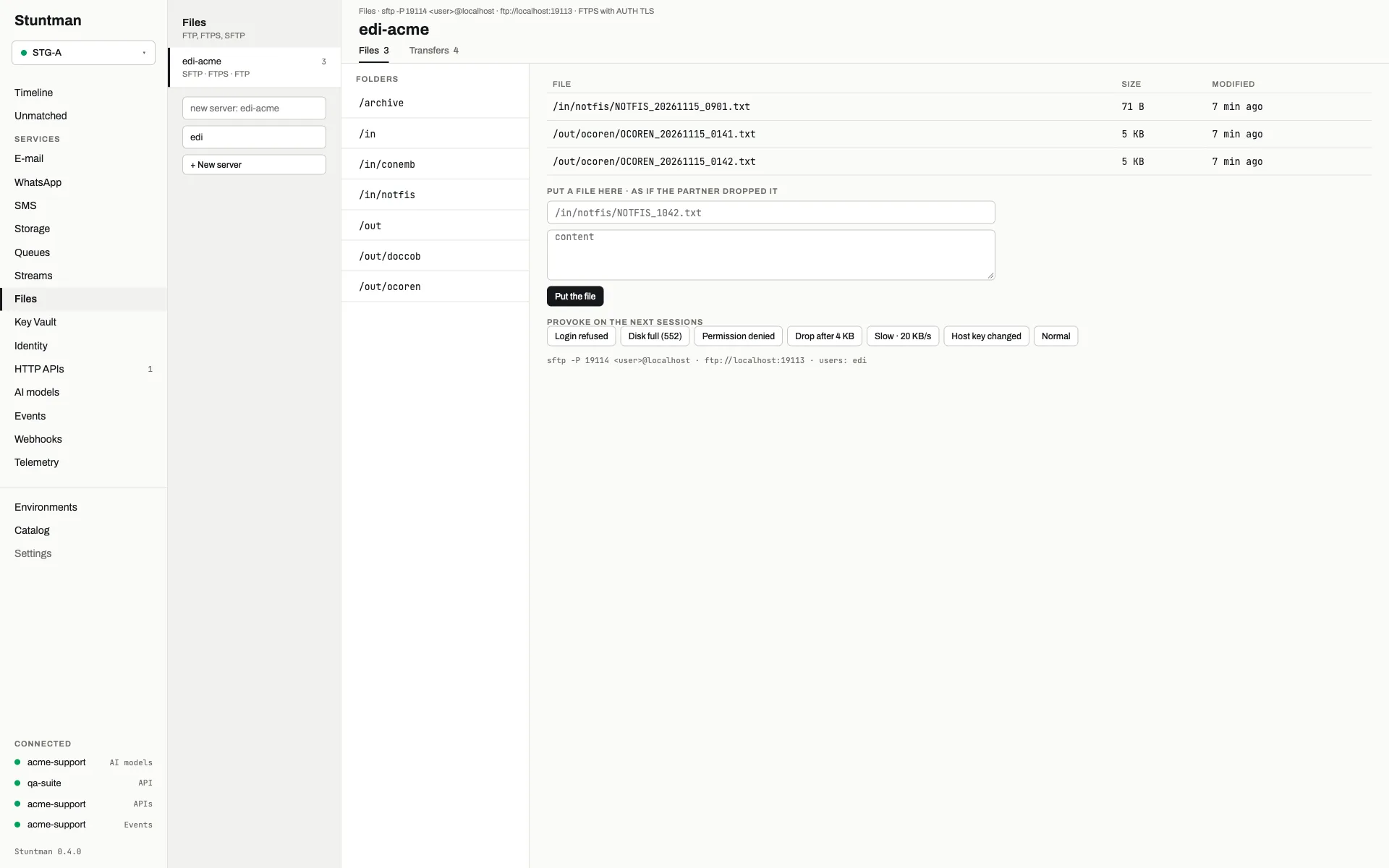
- FilesFTP, FTPS and SFTP servers where partners drop files and your app picks them up.
- Service Bus and RabbitMQAn AMQP broker that answers as Azure Service Bus or RabbitMQ and shows every message with its deliveries, locks and consumers.
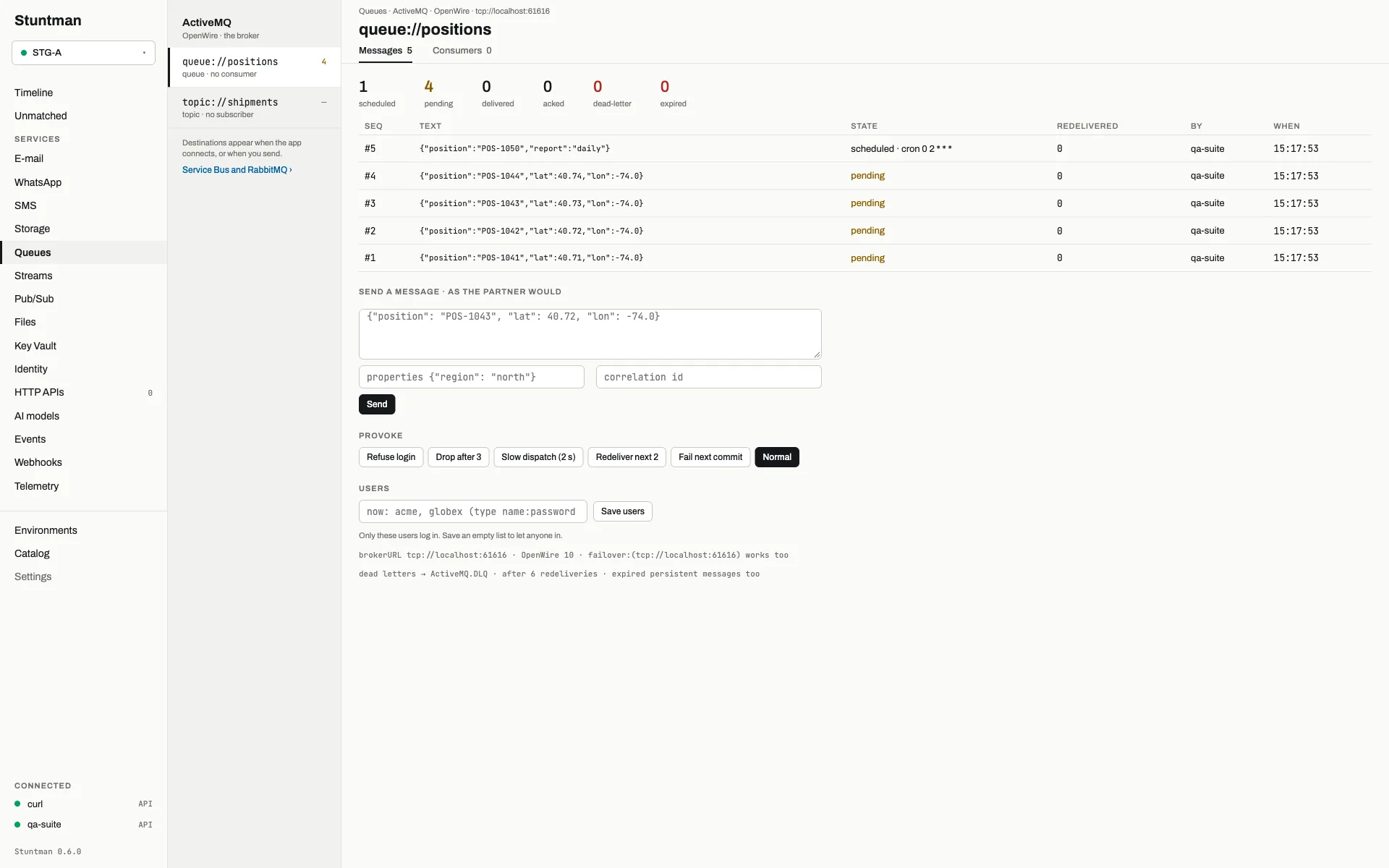
- ActiveMQAn ActiveMQ Classic broker over OpenWire, with transactions, durable subscriptions, selectors, the scheduler and dead letters.
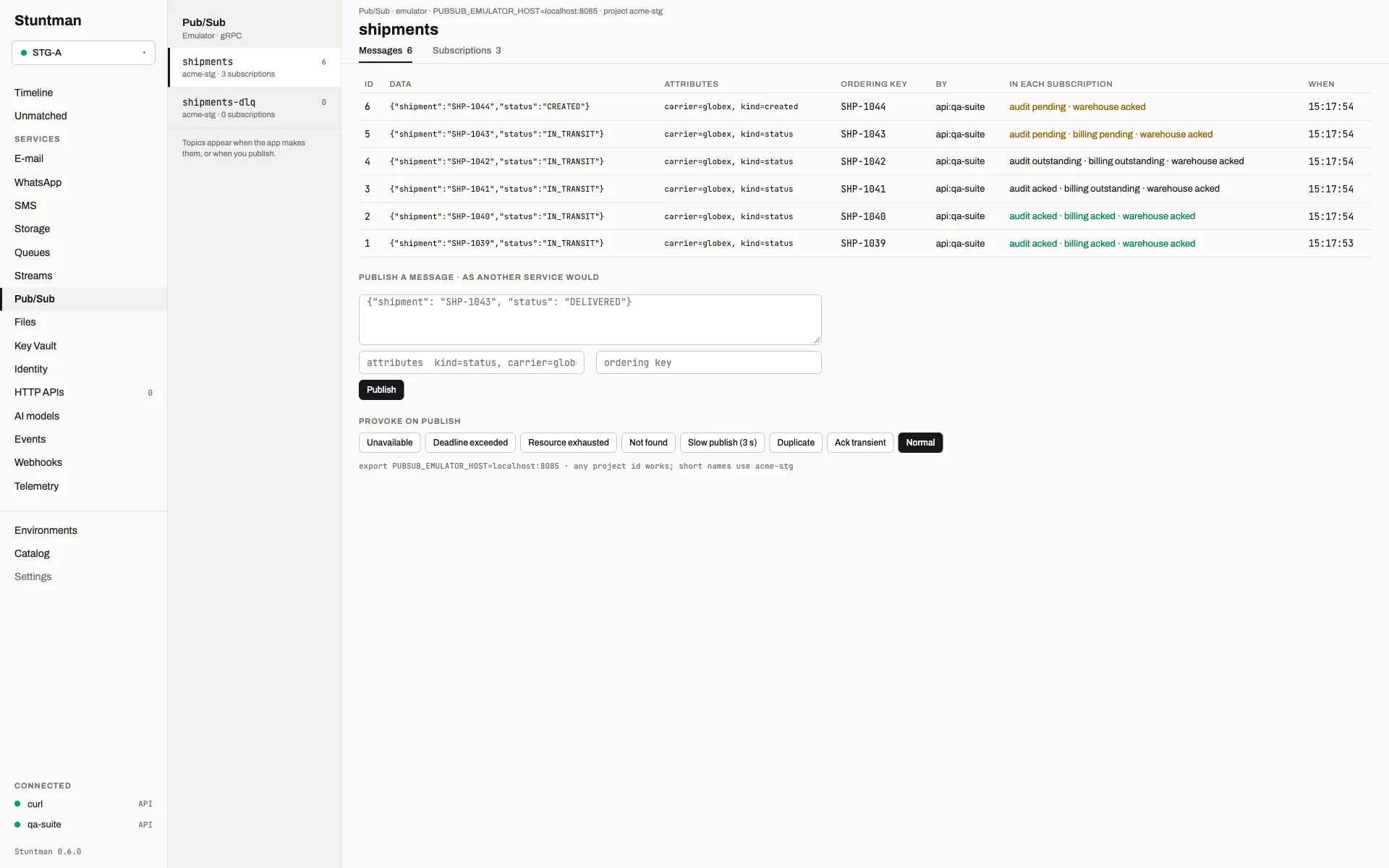
- Pub/SubA Google Cloud Pub/Sub emulator with schemas, snapshots, five subscription kinds, filters, transforms and exactly-once delivery.
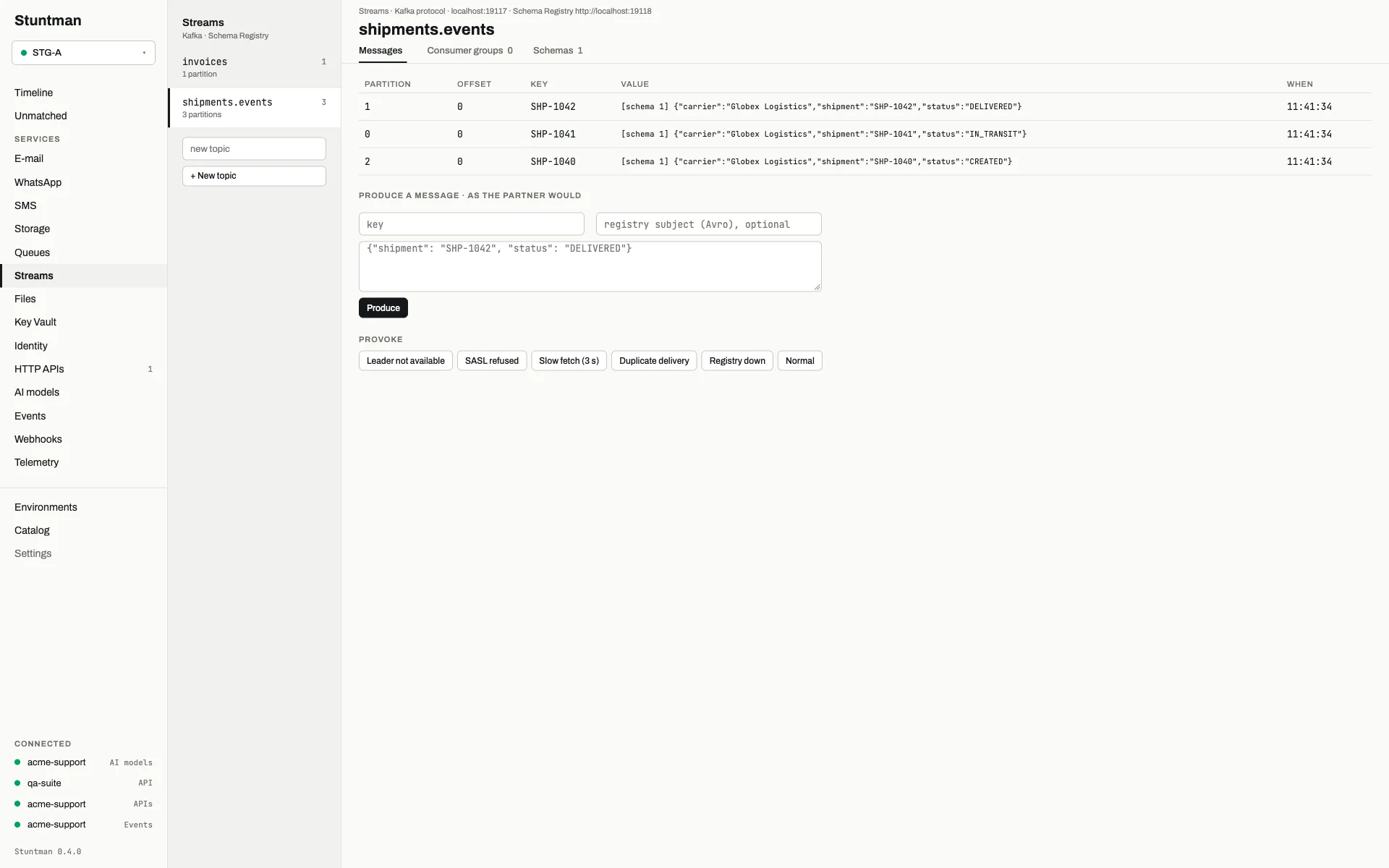
- StreamsA Kafka broker and a Confluent Schema Registry that decode every Avro message and break on cue.
- IdentityAn identity provider with synthetic people: OIDC and OAuth2, SAML, LDAP, password grant and Bot Framework.
- SecretsAn Azure Key Vault with synthetic secrets, keys that really sign, certificates and a log of every read.
- Webhook inboxesEndpoints your app sends its own webhooks to, answering however you need to test its retries.
- Product eventsThe analytics your app sends, kept per user and checked against a tracking plan.
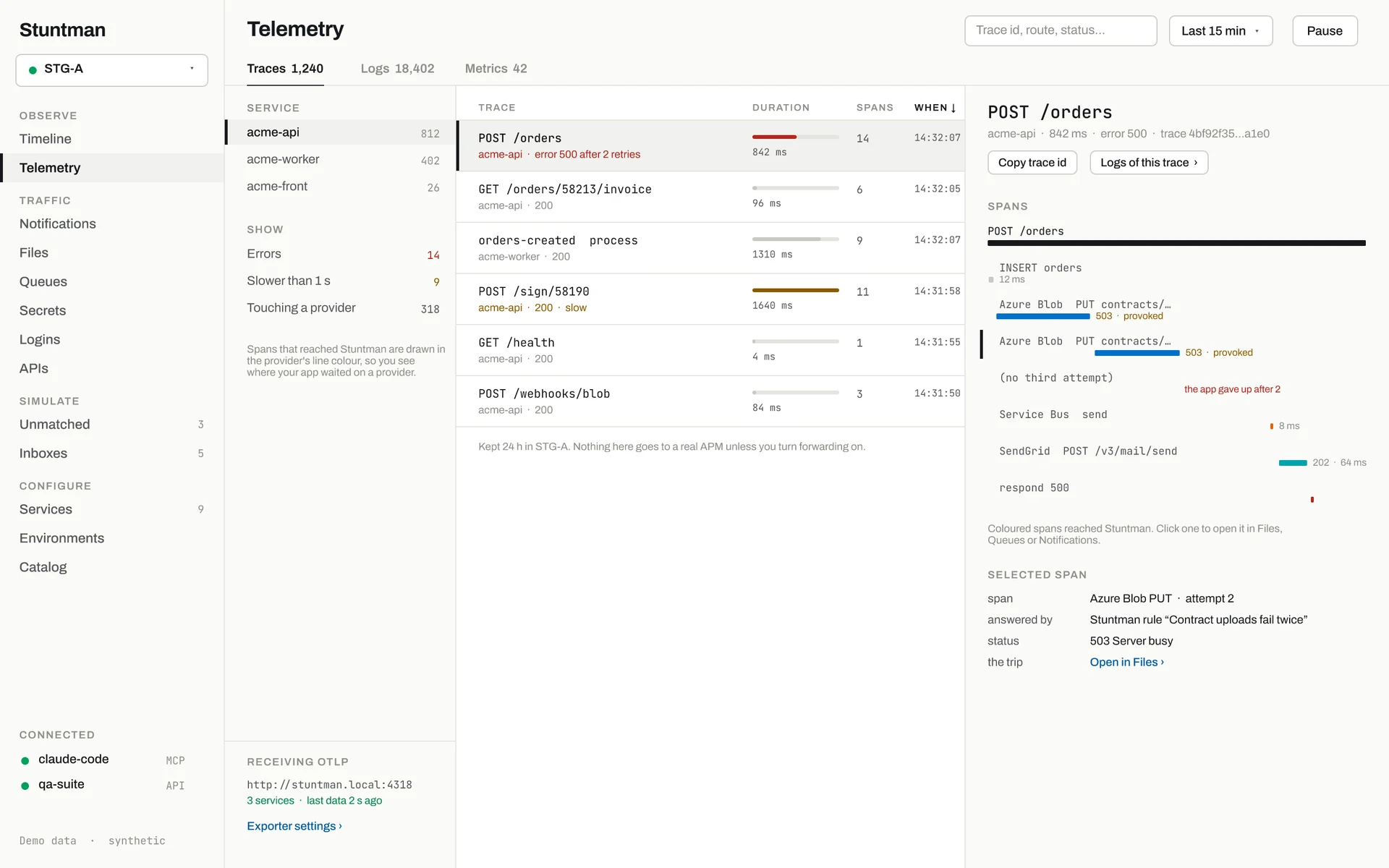
- TelemetryAn OpenTelemetry receiver that joins your app's spans to the provider calls Stuntman answered.
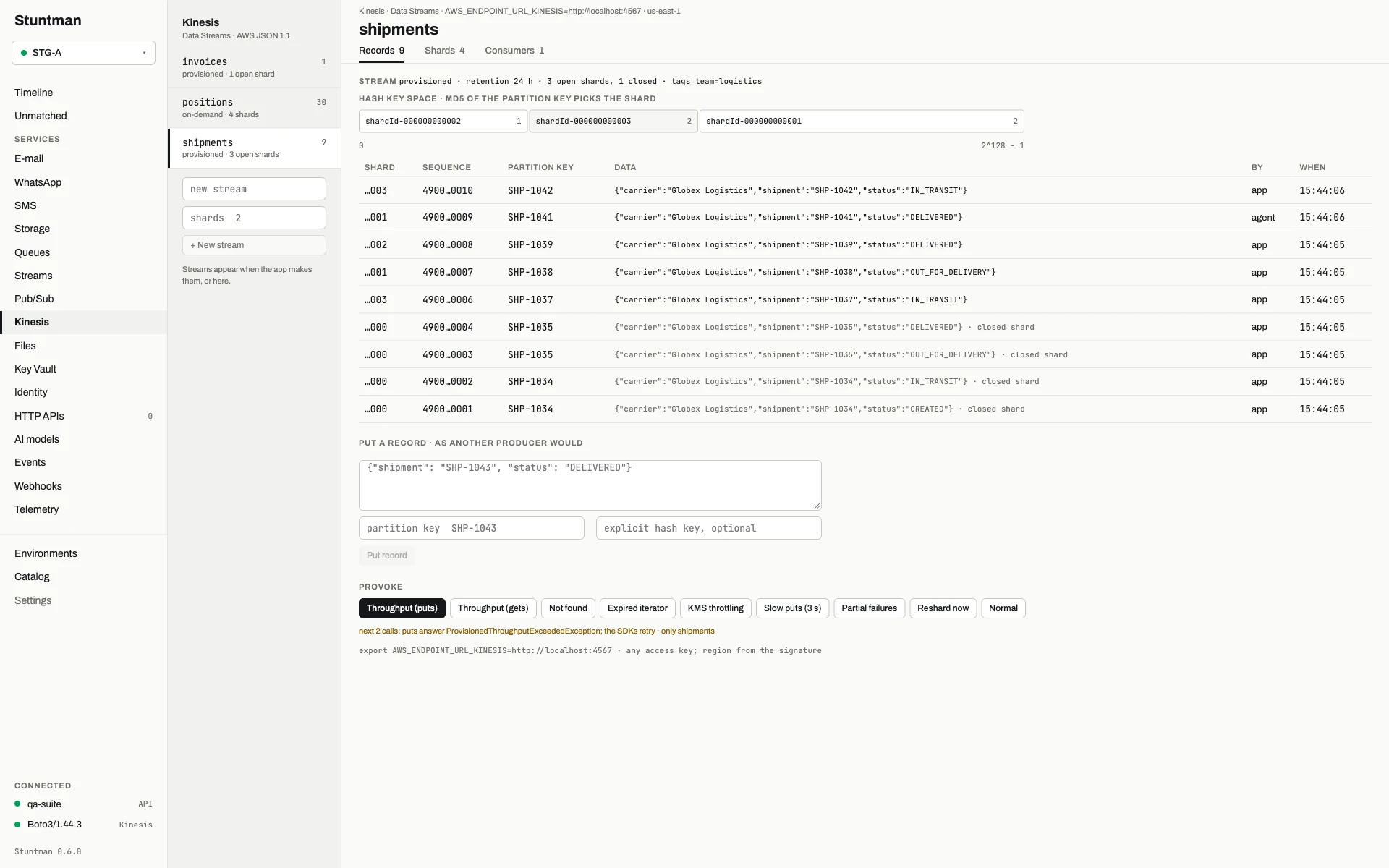
- KinesisAn Amazon Kinesis Data Streams endpoint the AWS SDKs talk to: shards by partition key, iterators, resharding, fan-out consumers and throttling on cue.
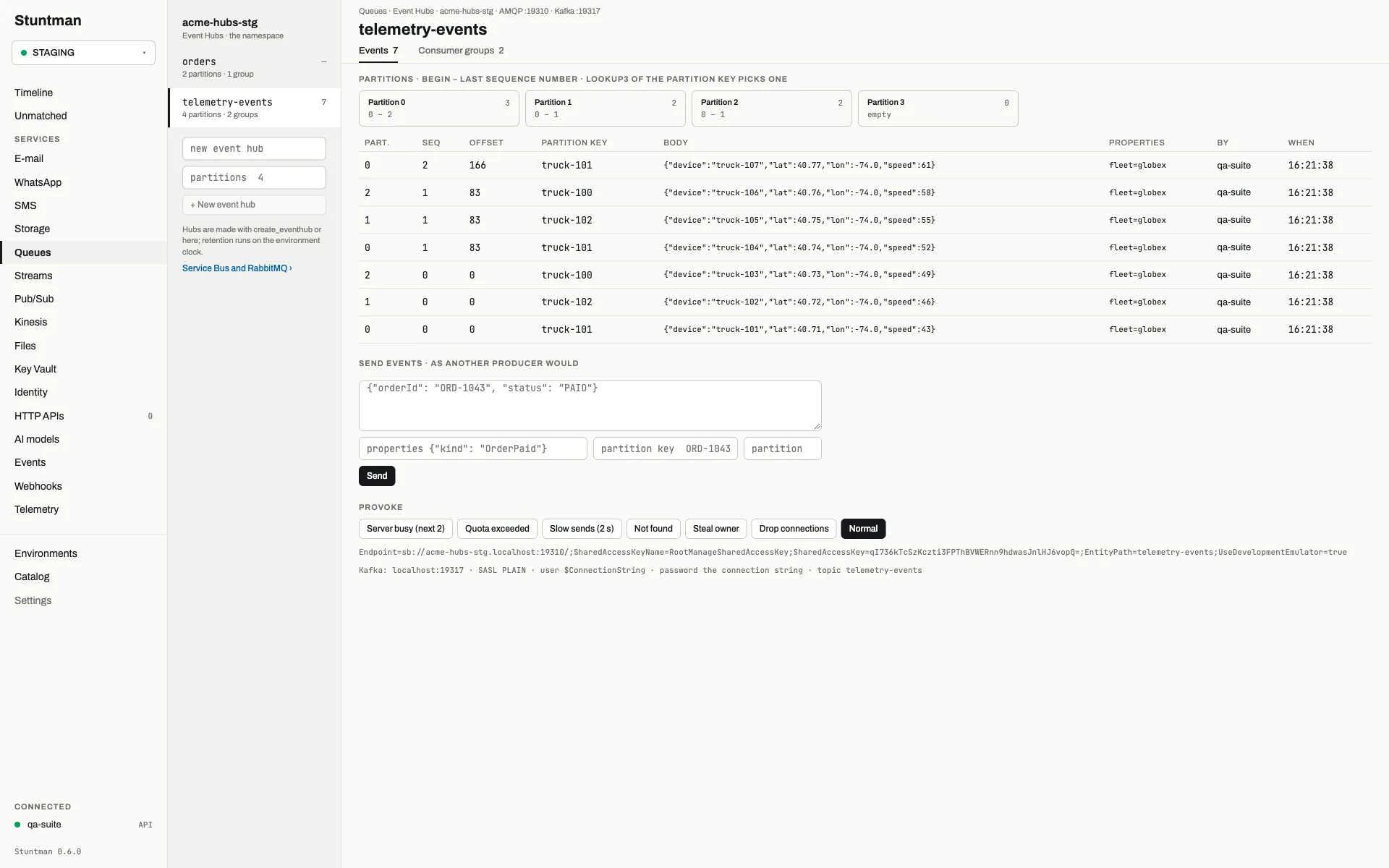
- Event HubsAn Azure Event Hubs namespace the official SDKs talk to over AMQP: partitions, consumer groups, owner levels, checkpoints and throttling on cue, with a Kafka endpoint too.
- Plugin catalog45 ready plugins for providers apps call every day, installed one at a time or a whole collection at once.
HTTP APIs
REST · GraphQL · OAuth2 · Basic · session cookies · mTLS · browser steps · streamed answers · MCP servers
It keeps. Routes, state per route and data tables, written in YAML; webhooks signed like Stripe, Svix, GitHub or CloudEvents; idempotency keys; scenarios.
You can provoke. Named answers, latency, 5xx, reset, timeout, cut streams, expired tokens, rate limits, badly signed or repeated webhooks.
Point your app at http://localhost:8028/<service>. 45 plugins in the catalog, from Stripe, PayPal and Pix to Shopify, Slack and Microsoft Graph. Plugins guide.
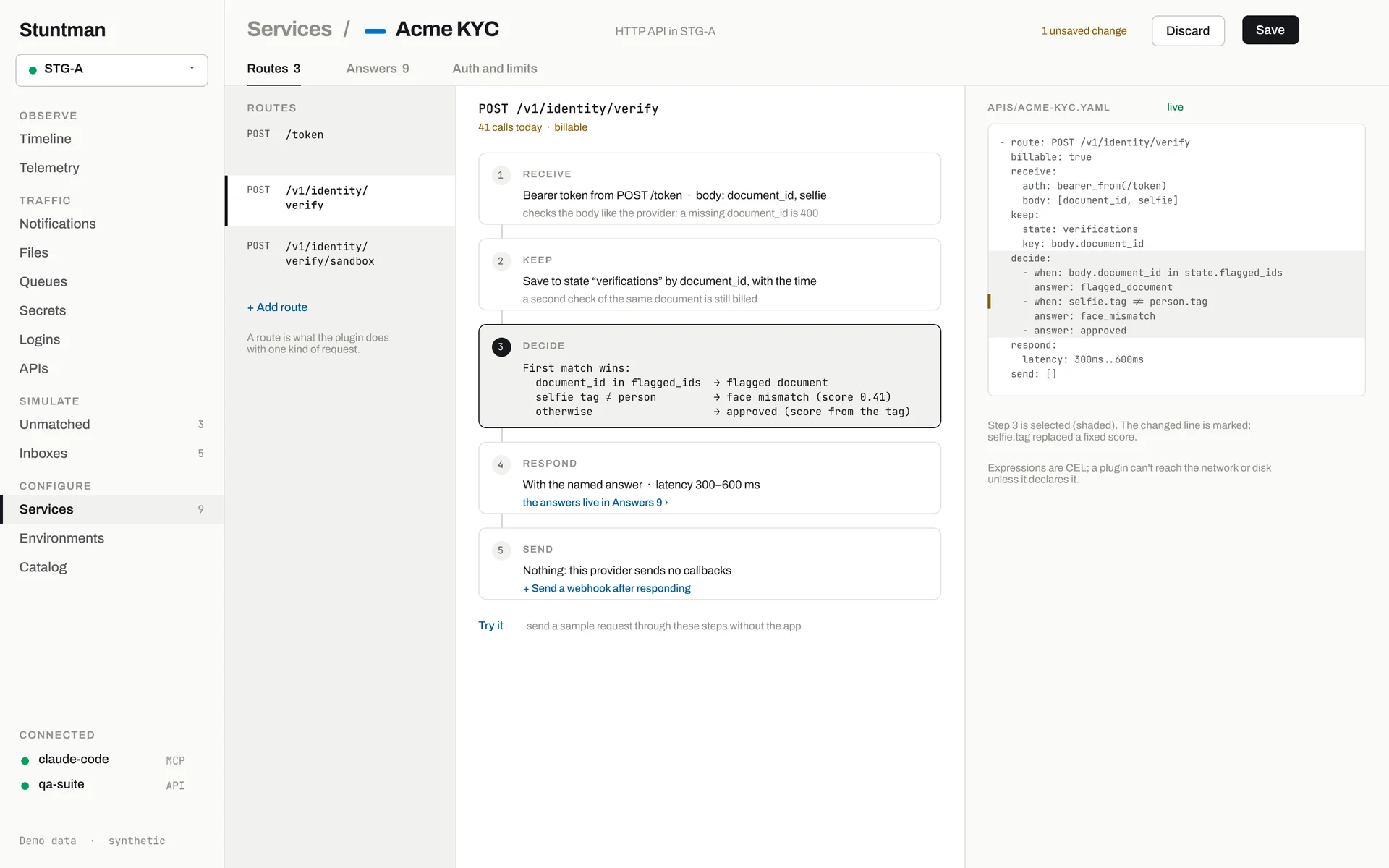
SOAP services
SOAP 1.1 and 1.2 · made from the WSDL · WS‑Security UsernameToken
It keeps. Operations from the WSDL with the same steps as routes; bodies checked against its XSD; the WSDL served back.
You can provoke. Any fault the WSDL declares, the provider's validation fault, refused credentials, slow or failed calls.
Create it with import_wsdl or + New service, then point your app at http://localhost:8028/<service><endpoint>. SOAP guide.
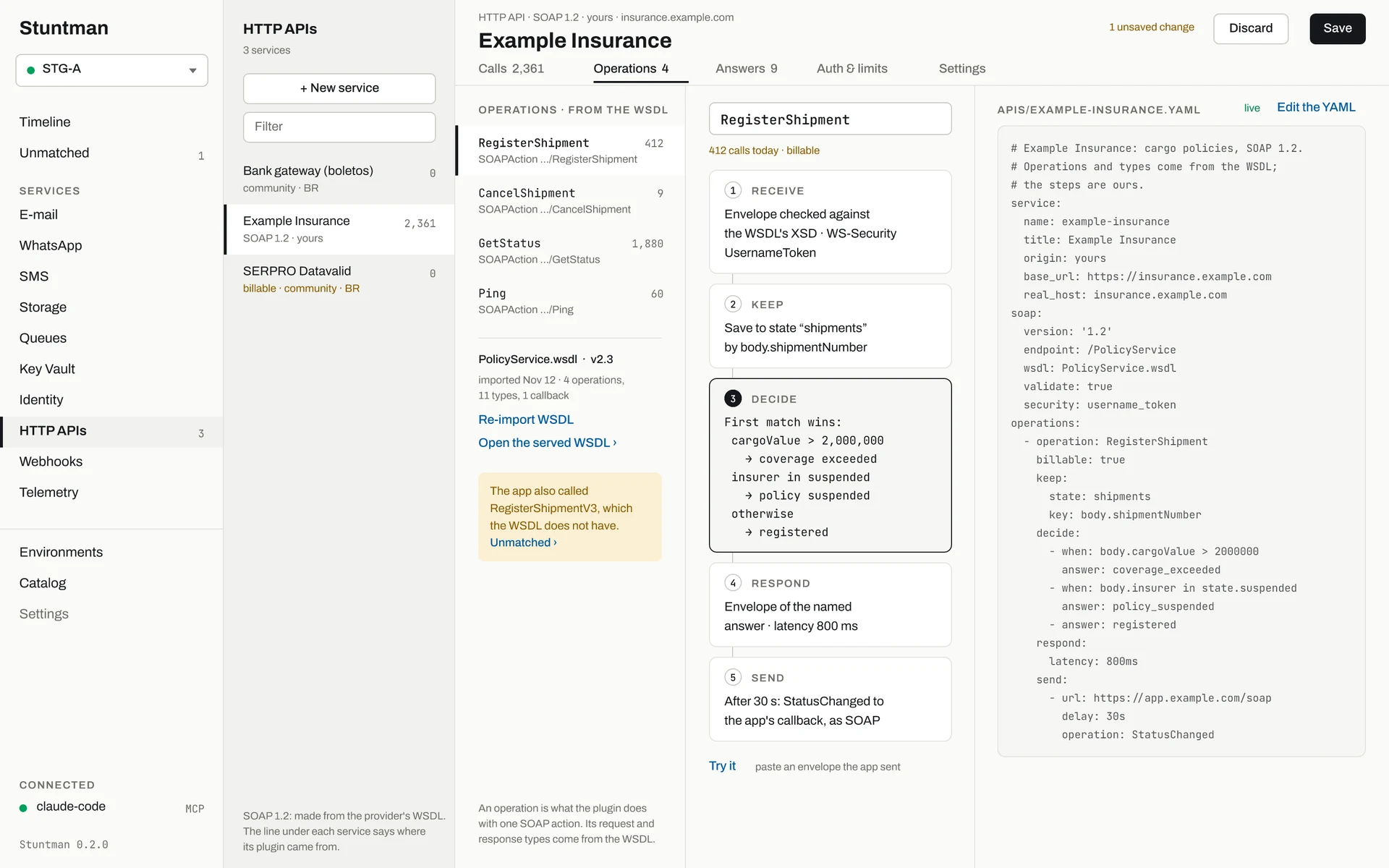
OpenAPI specs
OpenAPI 3.0 and 3.1 · Swagger 2.0 · JSON or YAML
It keeps. Routes from the paths; answers from the examples, or built from the schemas and echoing what the app sent; the spec served back.
You can provoke. Any response the spec declares, the provider's 400 or 422 for a body that does not match the schema, expired tokens, slow or failed calls.
Create it with import_spec or + New service, then point your app at http://localhost:8028/<service>. OpenAPI guide.
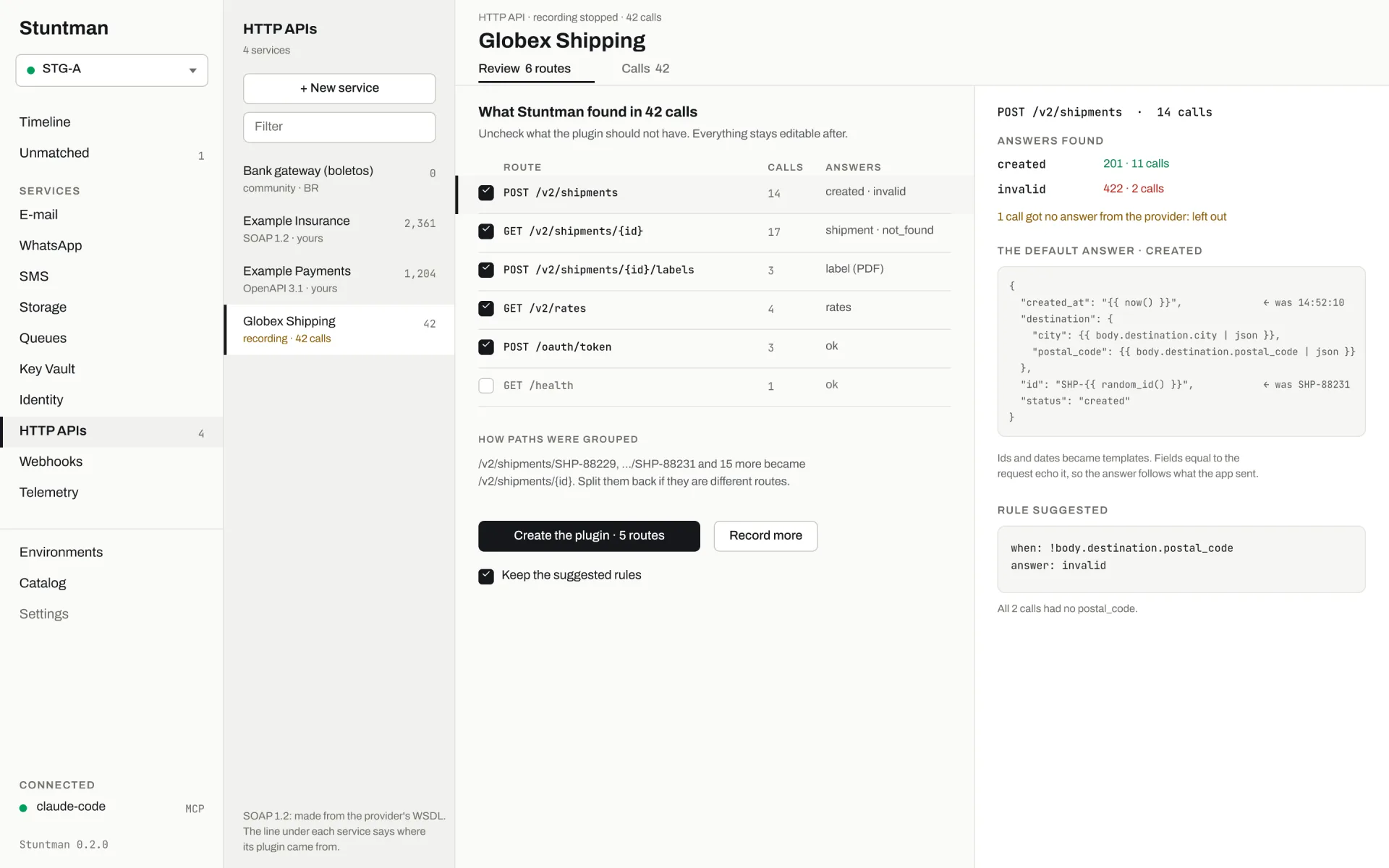
Recording
Your provider's sandbox · any HTTP API with no spec
It keeps. Each call goes to the sandbox and back, with secrets, cards, CPFs and e-mails masked; the review groups calls into routes, answers and rules.
You can provoke. Once the plugin is written: every answer the sandbox gave, plus anything a plugin can provoke. The sandbox is no longer called.
Start it with start_recording or + New service, stop, review, make_plugin. Recording guide.
WireMock mocks
WireMock mappings and __files · response templates
It keeps. Request patterns become routes, matchers become rules, responses become answers; scenarios, delays and faults come along.
You can provoke. Every answer the mocks gave, the scenario you pick, plus anything a plugin can provoke.
Import the folder with import_mocks; move scenarios with set_scenario. WireMock guide.
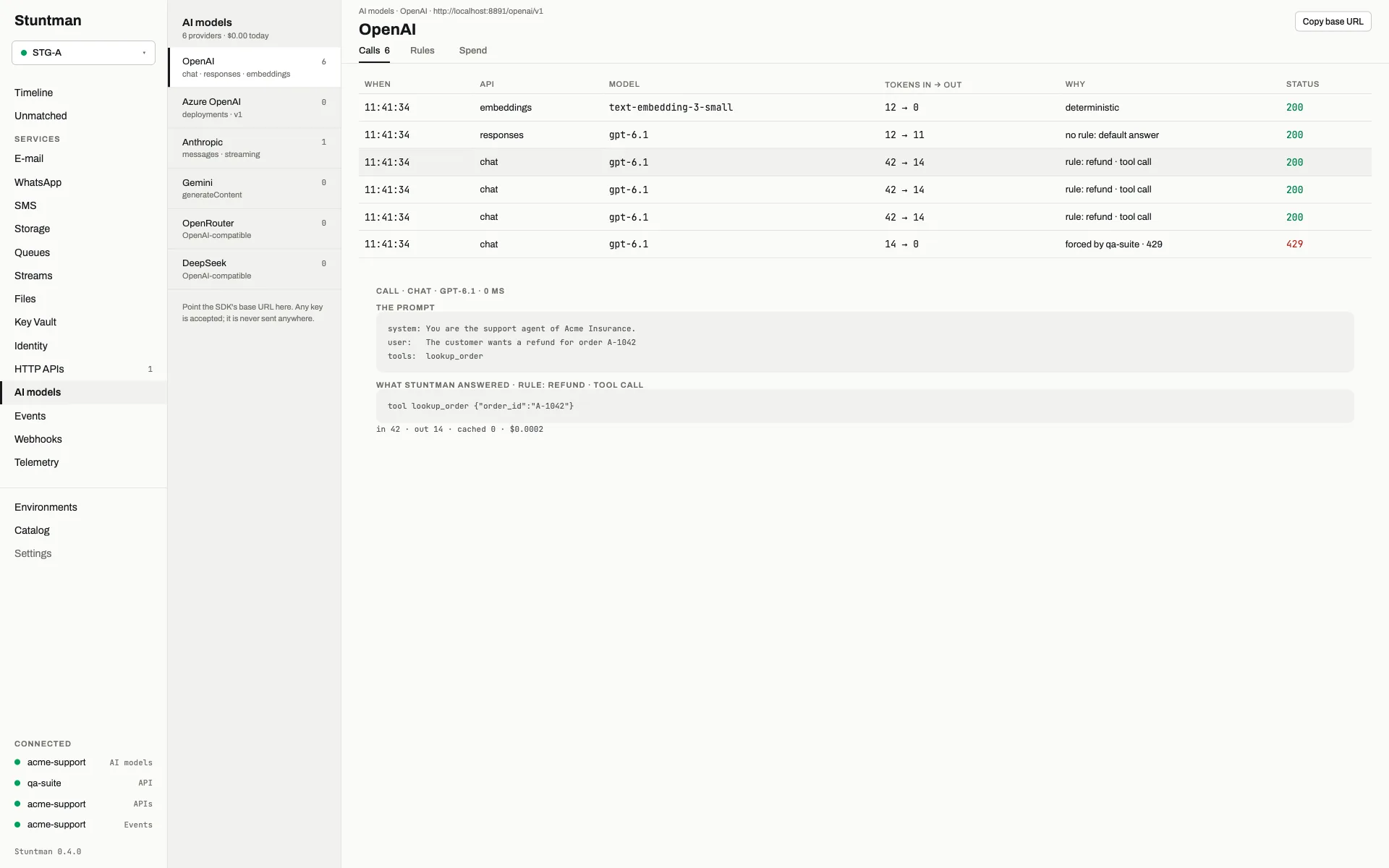
AI models
OpenAI · Azure OpenAI · Anthropic · Gemini · OpenRouter · DeepSeek
It keeps. Every call with its prompt, answer, tokens and cost; rules that pick the text, a tool call or JSON.
You can provoke. 429, 500, 529 overloaded, content filter, cut by max_tokens, broken tool arguments, slow or cut streams.
SDK base URL http://localhost:8025/openai/v1, …/anthropic, …/gemini; any key.
SMS
Zenvia API v2
It keeps. Messages, delivery steps per recipient, opt-outs.
You can provoke. 500, 400, reset, empty reply, timeout; the person texts back, STOP and START.
Point your app at http://localhost:8025/zenvia/v2/channels/{0}/messages.
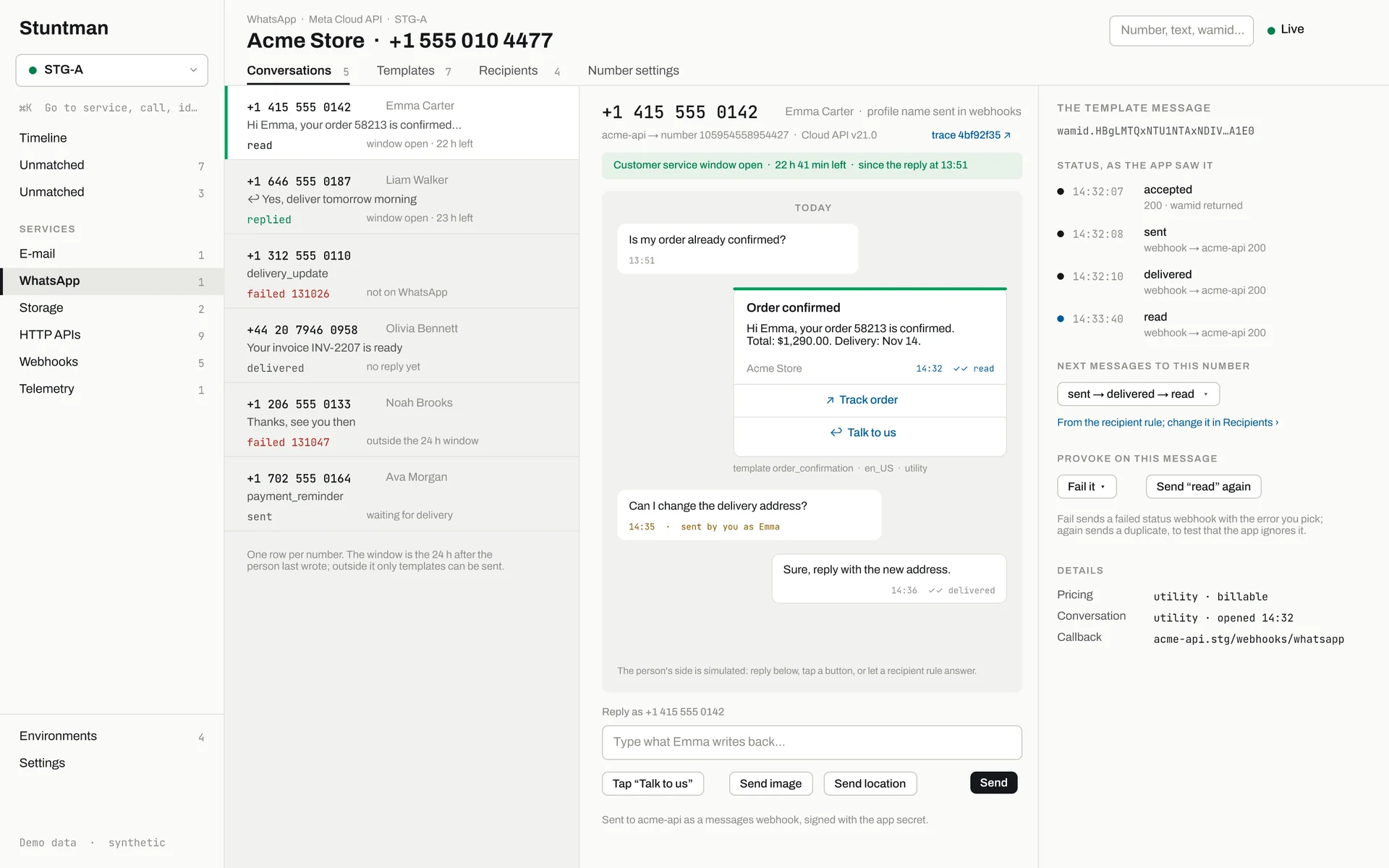
Meta WhatsApp Cloud API (Graph)
It keeps. Conversations, templates, the 24-hour window and the recipients.
You can provoke. 500, 400, connection failures, expired tokens, replies, wrongly signed or replayed webhooks.
Graph base URL http://localhost:8025/whatsapp.
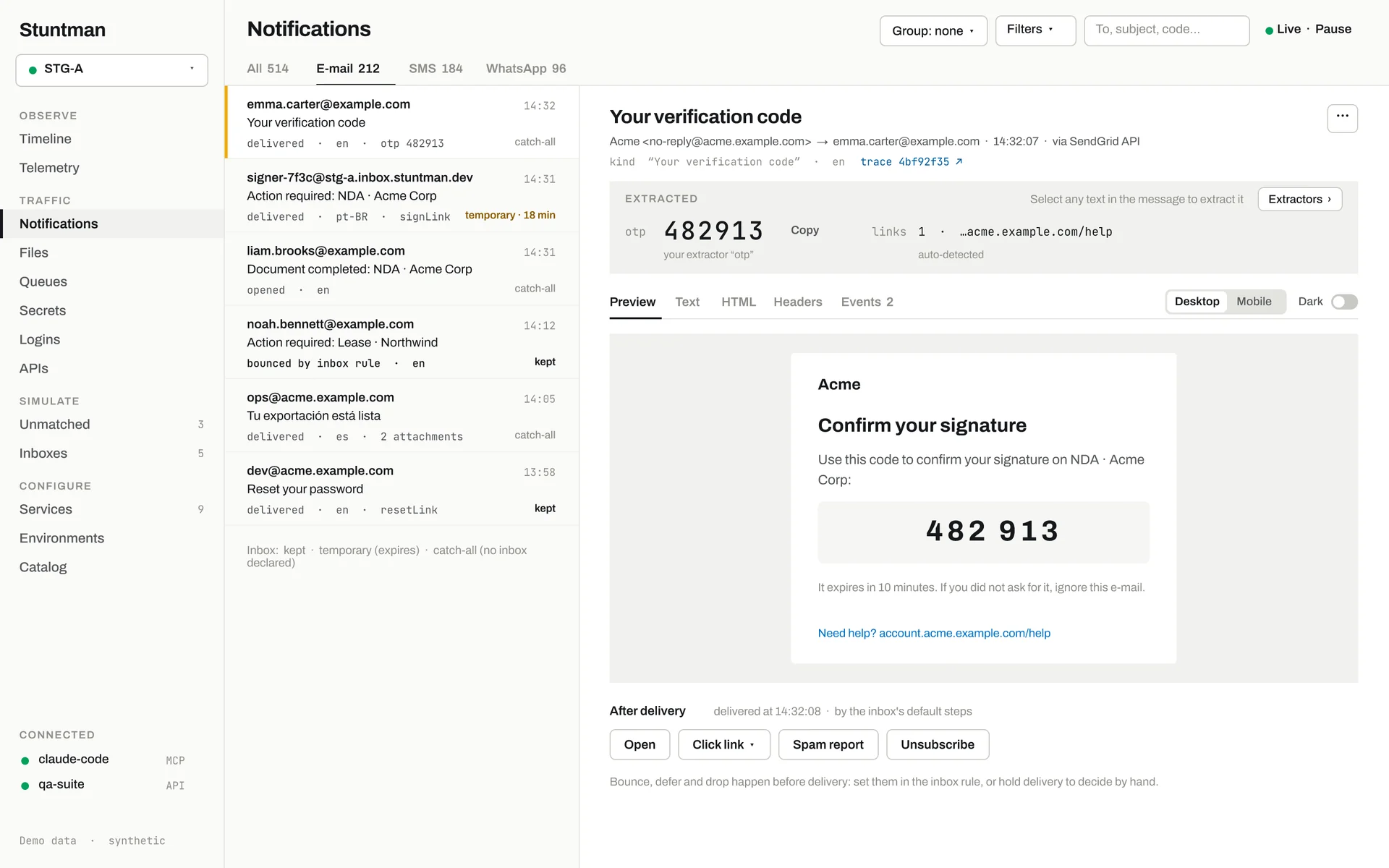
SMTP with STARTTLS · SendGrid v3 · signed Event Webhook
It keeps. Every message with its HTML, attachments and extracted codes and links.
You can provoke. Hold and decide: deliver, defer, bounce, drop; open, click, spam report, unsubscribe.
SMTP localhost:2525 · SendGrid http://localhost:8025/sendgrid.
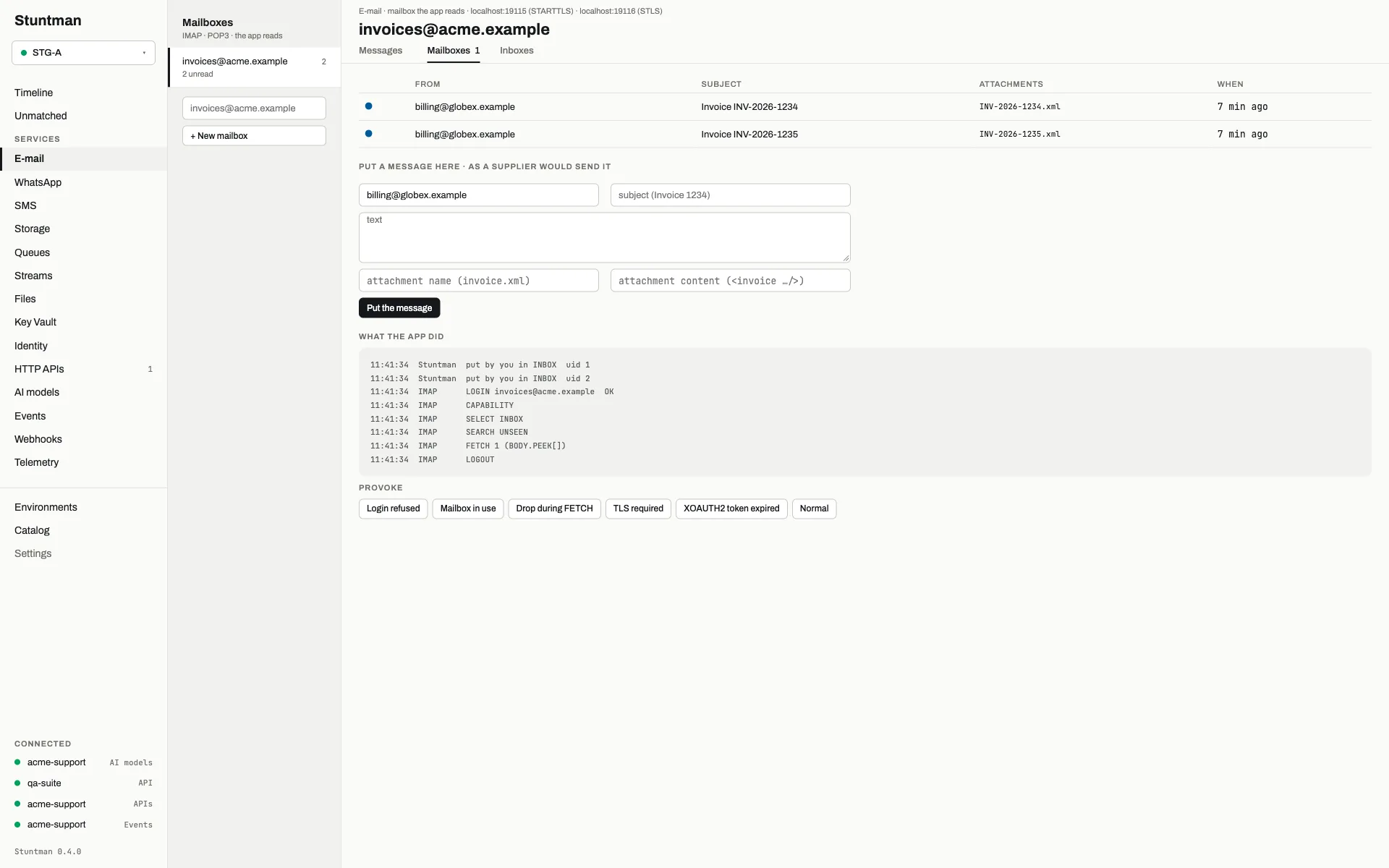
Mailboxes
IMAP4rev1 (STARTTLS, XOAUTH2, IDLE, MOVE) · POP3
It keeps. Mailboxes the app reads: folders, flags, and every command it sent.
You can provoke. Logins refused, mailbox in use, a connection dropped during FETCH, TLS required, XOAUTH2 token expired.
IMAP localhost:1143 · POP3 localhost:1110; put mail in with put_mail.
Storage
Azure Blob (SharedKey, SAS) · Amazon S3 (SigV4)
It keeps. Accounts, containers, objects, uploads, presigned links and their events.
You can provoke. 503 on the first N attempts, 403/404, slow or truncated reads, bad links, lost or duplicated events.
Blob :10000/<account> · S3 :9000.
Files
FTP · explicit FTPS · SFTP
It keeps. Servers as folders, their users, and every login and transfer.
You can provoke. Logins refused, disk full, permission denied, a transfer cut halfway or crawling, a changed SFTP host key.
FTP localhost:2121 · SFTP localhost:2222; drop files with put_file.
Messaging
Azure Service Bus · RabbitMQ (AMQP) · RabbitMQ management API · Apache ActiveMQ (OpenWire: transactions and XA, durable subscriptions, selectors, scheduler, DLQ, advisories)
It keeps. Queues, topics, subscriptions, every message with its deliveries, consumers and locks.
You can provoke. Lost locks, duplicates, held, dropped, dead-lettered or out-of-order messages; a busy or refusing namespace; a refused login or a connection dropped mid-queue.
AMQP :5673 (TLS :5671) · management API :15672 · ActiveMQ tcp://localhost:61616.
Pub/Sub
Google Cloud Pub/Sub (gRPC, as the official emulator) · REST publish · schemas · snapshots · push, BigQuery, Cloud Storage and Bigtable subscriptions · filters · JavaScript and AI transforms · ingestion
It keeps. Topics, subscriptions, every message with its ack state, ordering keys and attributes; dead-letter topics; the rows and files the export subscriptions wrote.
You can provoke. UNAVAILABLE, DEADLINE_EXCEEDED, RESOURCE_EXHAUSTED or NOT_FOUND on the next publishes, slow publishes, a message delivered twice, an ack deadline that expires.
PUBSUB_EMULATOR_HOST=localhost:8085; the official clients need nothing else.
Kinesis
Amazon Kinesis Data Streams (AWS JSON 1.1 and CBOR) · enhanced fan-out
It keeps. Streams, shards with their hash ranges, every record with its sequence number, consumers and resharding.
You can provoke. Throughput exceeded on puts or gets, expired iterators, KMS throttling, partial PutRecords failures, slow puts, a reshard right now.
AWS_ENDPOINT_URL_KINESIS=http://localhost:4567; any access key.
Event Hubs
Azure Event Hubs over AMQP · its Kafka endpoint
It keeps. Hubs, partitions with sequence numbers and offsets, consumer groups, owner-level receivers and checkpoints.
You can provoke. Server busy, quota exceeded, slow sends, a stolen partition owner, not found, dropped connections.
Endpoint=sb://<namespace>.localhost:5673/;…;EntityPath=<hub> · Kafka $ConnectionString.
Streams
Kafka (SASL PLAIN, SCRAM) · Confluent Schema Registry · Avro
It keeps. Topics, partitions, consumer groups with their lag, schemas and decoded messages.
You can provoke. Leader not available, SASL refused, slow fetches, duplicated records, rebalances, registry down, a bad schema id.
bootstrap.servers=localhost:9092 · schema.registry.url=http://localhost:8081.
Identity
OIDC / OAuth2: Microsoft Entra ID, Google, Okta, generic OIDC · password grant · SAML 2.0 · LDAP · Bot Framework
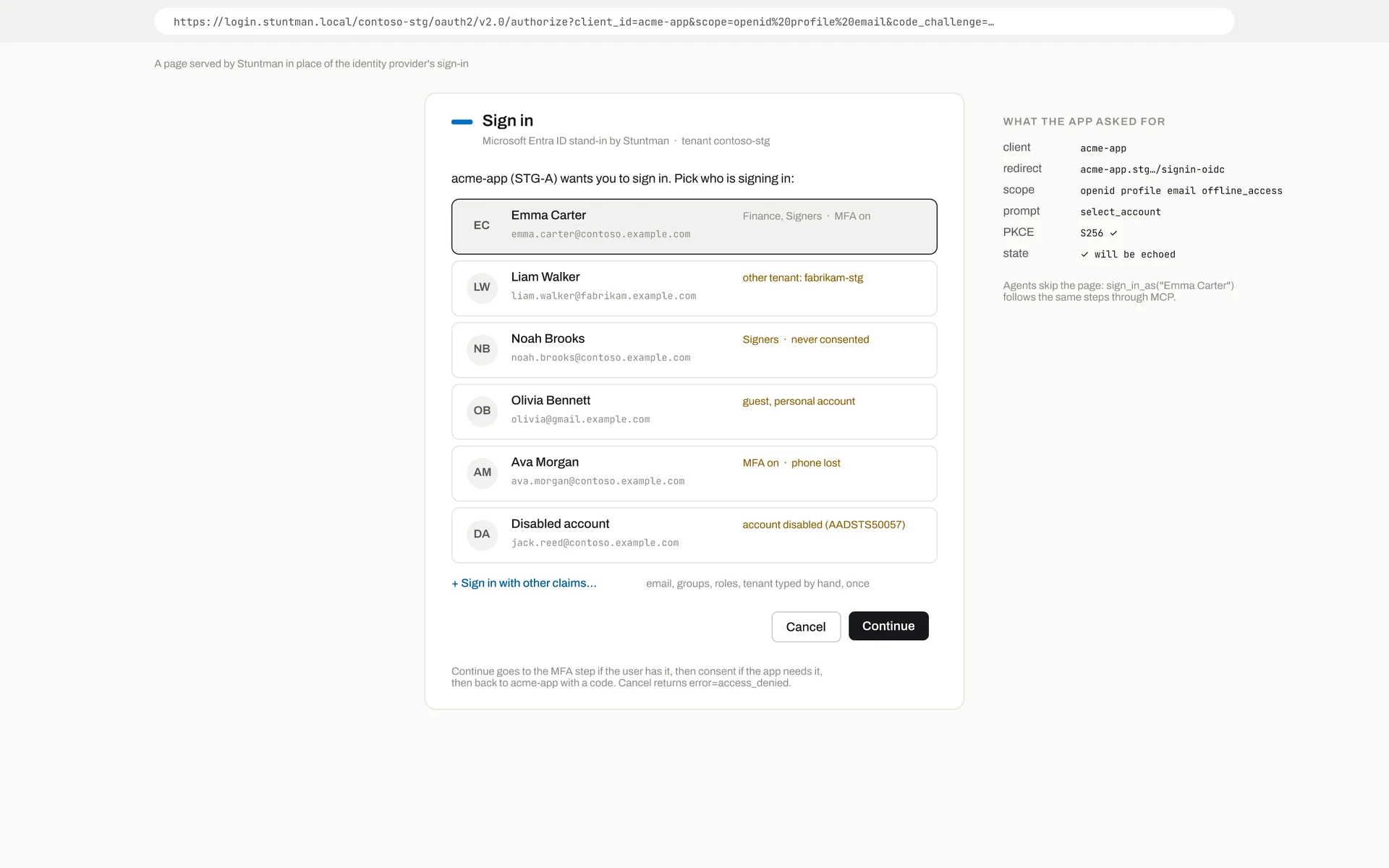
It keeps. Tenants, apps, synthetic users and their claims; a sign-in page you can drive; signed SAML assertions; an LDAP directory of the same people.
You can provoke. MFA, consent, user cancels, wrong tenant, expired tokens, bad signatures, IdP down, locked accounts.
Use the authority shown in the provider's settings in the UI; LDAP on localhost:3389.
Secrets
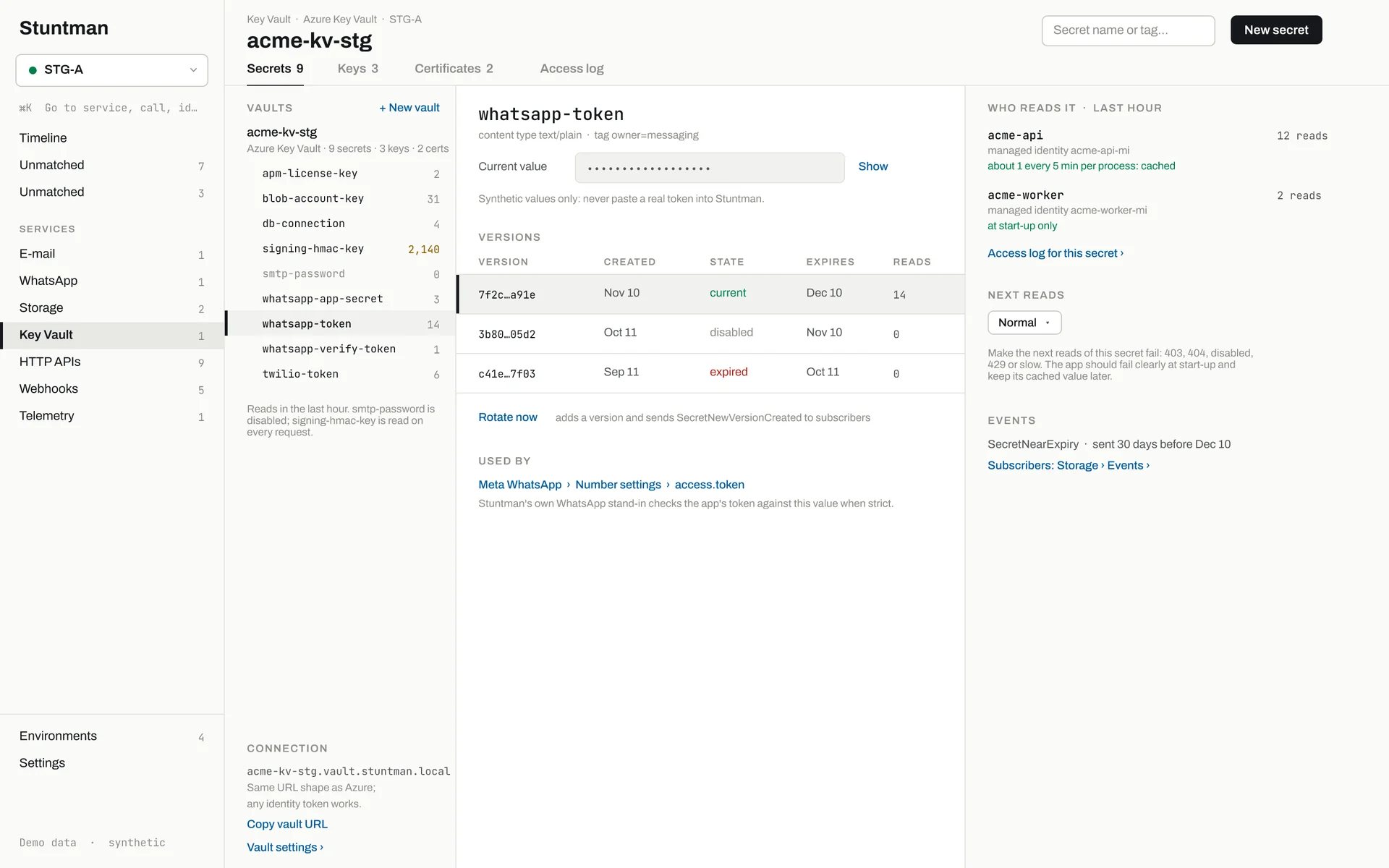
Azure Key Vault · managed identity
It keeps. Versions, keys that really sign and wrap, certificates, read counts that prove caching.
You can provoke. 403, 404, 429, disabled, slow, expired or untrusted certificates, wrong signatures.
https://<vault>.vault.<base domain>:8444; trust the Test CA.
Webhook inboxes
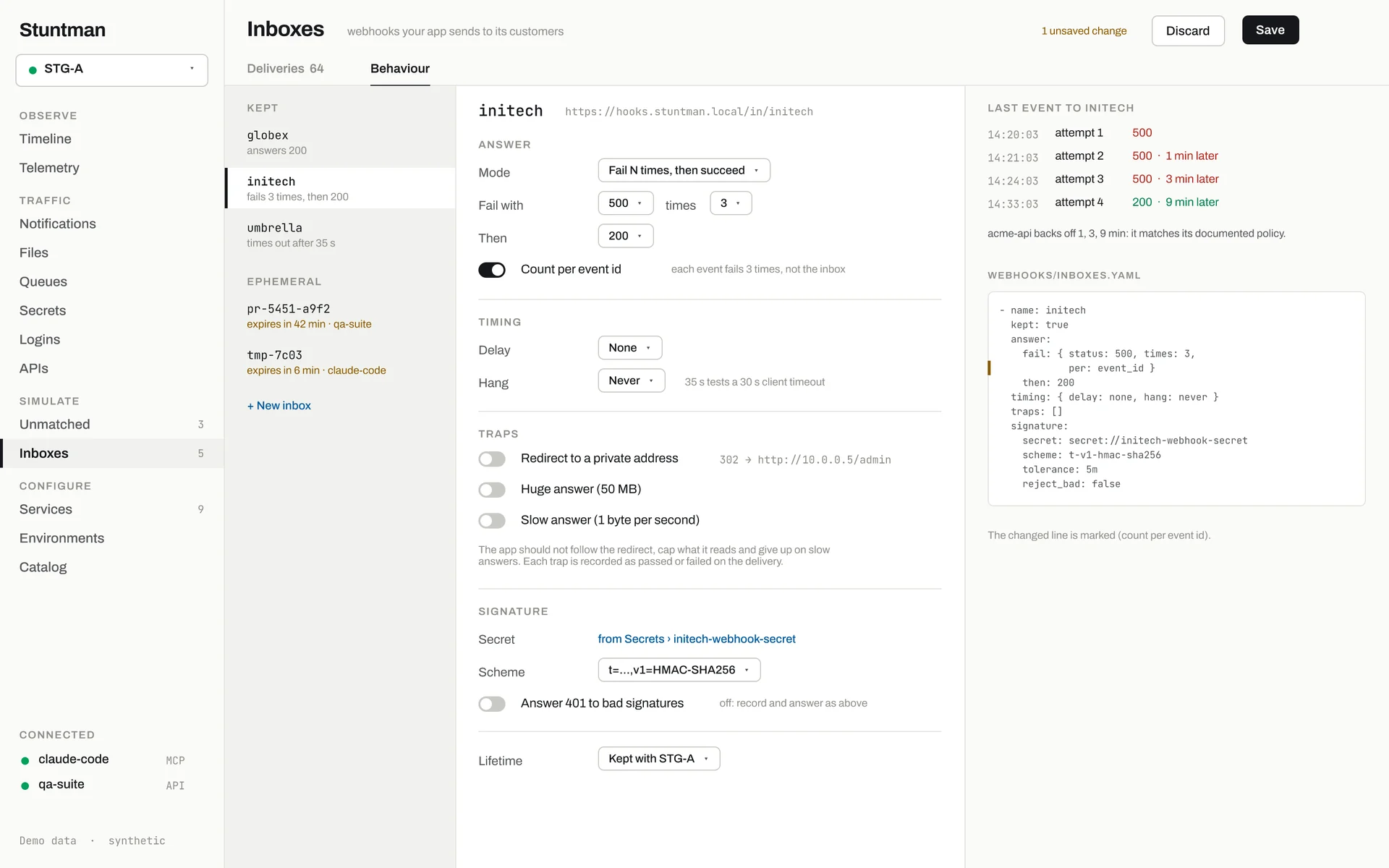
Endpoints your app sends its own webhooks to
It keeps. Every delivery with its signature check; inboxes that expire by themselves.
You can provoke. 200, 500, timeout, hang, delay, fail twice then succeed.
http://localhost:8027/in/<inbox>.
Product events
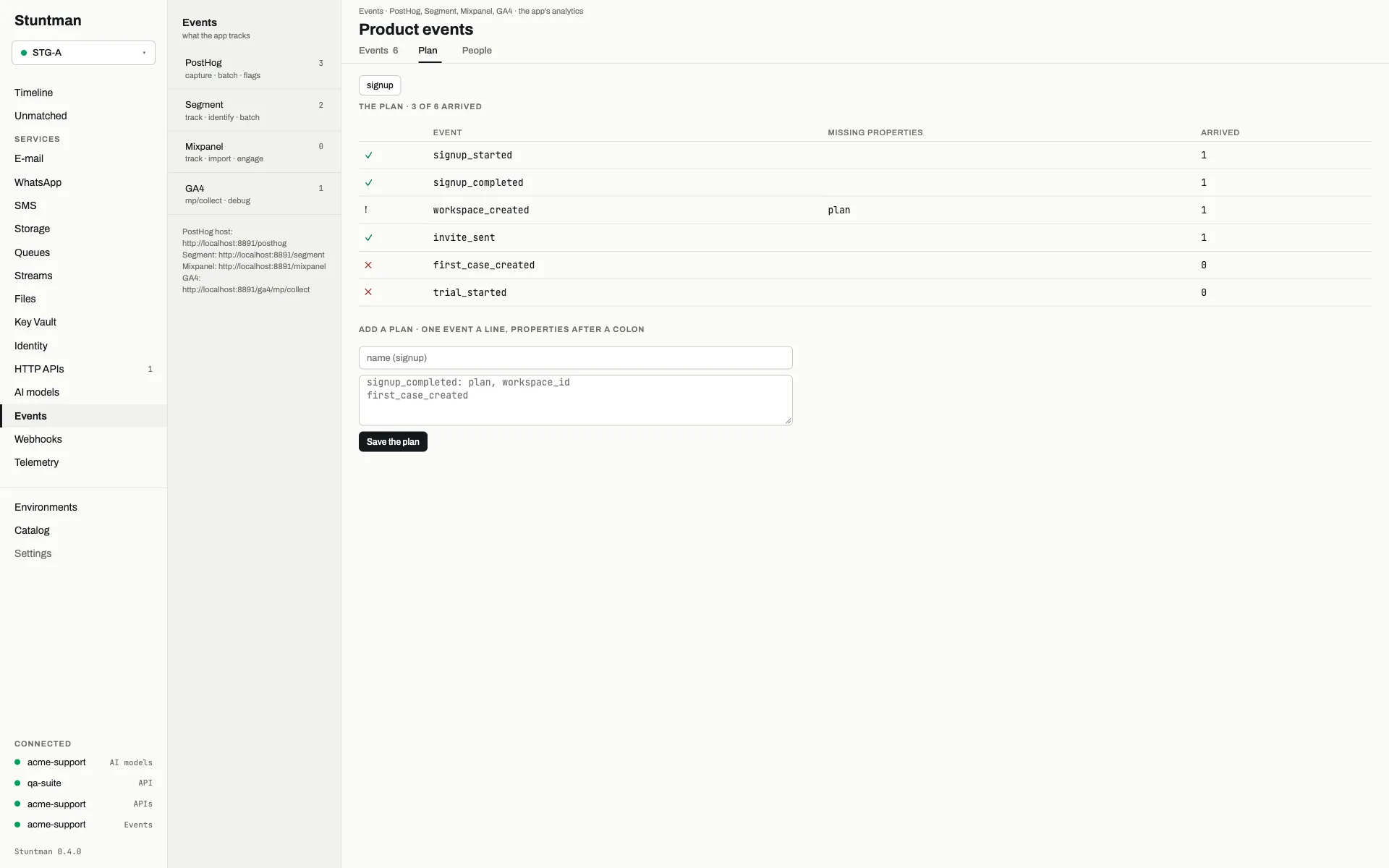
PostHog · Segment · Mixpanel · GA4 Measurement Protocol
It keeps. Every event per user, personal data flagged; tracking plans a CI run can check.
You can provoke. 400, 413, 429, a slow collector, half the events lost.
SDK host http://localhost:8025/posthog, …/segment, …/mixpanel, …/ga4.
Telemetry
OpenTelemetry: OTLP logs, traces, metrics · GELF · StatsD
It keeps. Spans joined to the provider calls that caused them.
You can provoke. A collector that refuses, rejects, throttles, slows or drops half; hosts still called directly.
OTEL_EXPORTER_OTLP_ENDPOINT=http://localhost:4318 · GELF :12201/udp · StatsD :8125/udp.