Everything Streams gives you
- 01
The real Kafka protocol
Produce, Fetch, ListOffsets, Metadata, CreateTopics and consumer groups with JoinGroup, SyncGroup, Heartbeat and offset commits.
- 02
Avro, decoded
Values in Confluent framing are decoded with their registry schema, so you read JSON, not bytes. JSON and text values too.
- 03
A Schema Registry
Confluent-compatible subjects and versions; register Avro, JSON or Protobuf schemas. The same schema keeps its id.
- 04
Produce as the partner
produce sends a key, value, headers and partition; with a subject the value is Avro-encoded with that schema.
- 05
Consumer groups and lag
Members, assigned partitions and the lag of each partition: committed offset against the high watermark.
- 06
Force a rebalance
rebalance makes members get REBALANCE_IN_PROGRESS on their next heartbeat, so they must join again.
- 07
SASL logins
PLAIN and SCRAM-SHA-256/512. With sasl_required and no users listed, any user works and any password except wrong.
- 08
Broker-level failures
Leader not available, SASL refused, slow fetch, duplicated records and a Schema Registry that answers 503.
The screens
Each number is a control or a reading on the real screen. Everything you can click there, your agent can do with a tool.
Topics and decoded messages
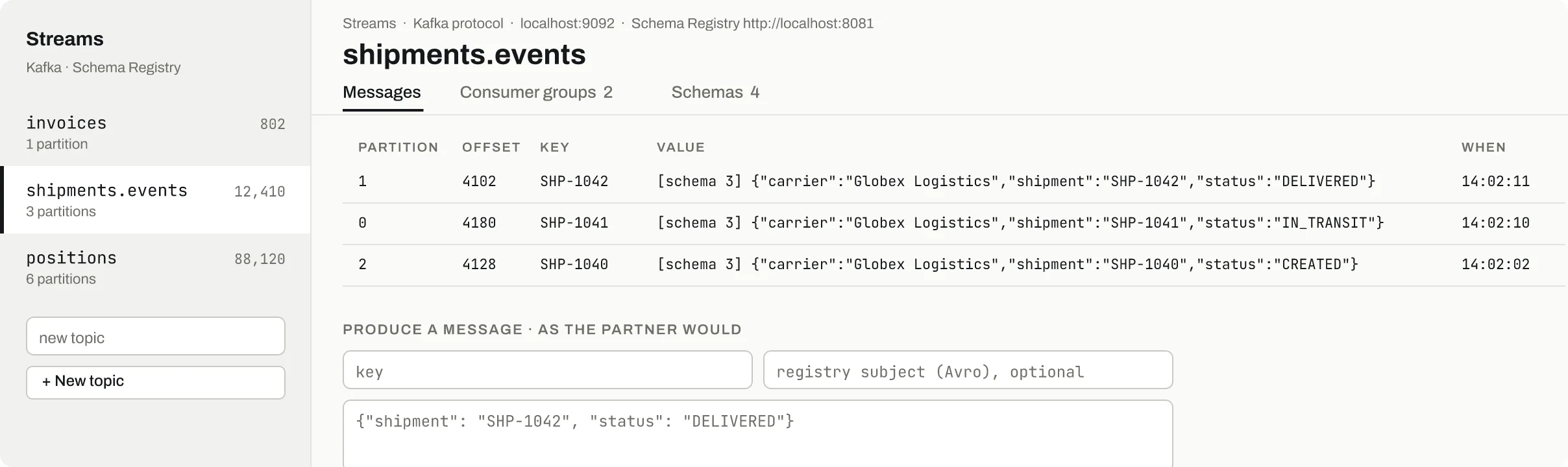
Each topic with its partitions and message count; made when a client asks, unless auto_create is off.
Kafka on localhost:9092 and the Schema Registry on :8081.
Where each record landed, to check keys go to the partition the app expects.
The value decoded with schema 3 from the registry, not raw bytes.
- Topics
Each topic with its partitions and message count; made when a client asks, unless auto_create is off.
- How to connect
Kafka on localhost:9092 and the Schema Registry on :8081.
- Partition and offset
Where each record landed, to check keys go to the partition the app expects.
- Avro, readable
The value decoded with schema 3 from the registry, not raw bytes.
Produce and provoke
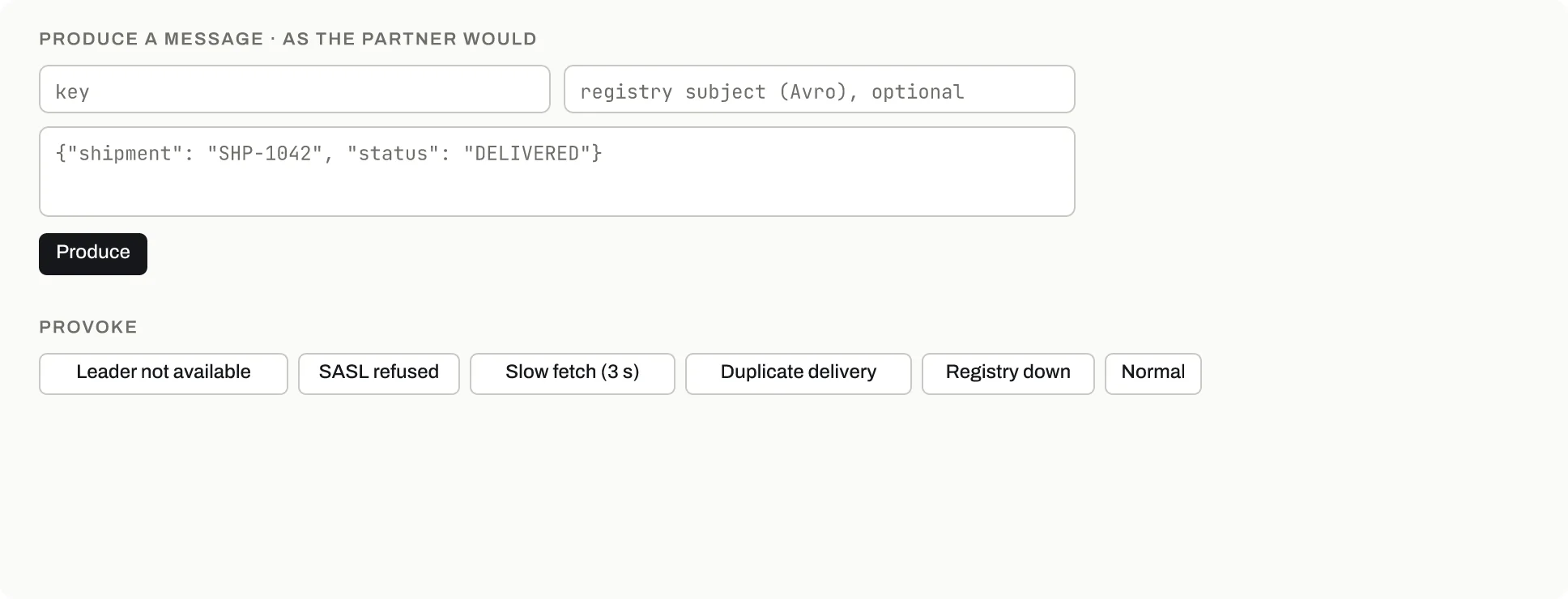
The record key, which picks the partition as a real producer would.
With a subject, the value is Avro-encoded with that schema in Confluent framing.
Sends the record as the partner would; the app's consumer reads it on its next fetch.
Producers and consumers get LEADER_NOT_AVAILABLE until you set Normal.
The Schema Registry answers 503: does the app retry or drop the record?
- Key
The record key, which picks the partition as a real producer would.
- Registry subject
With a subject, the value is Avro-encoded with that schema in Confluent framing.
- Produce
Sends the record as the partner would; the app's consumer reads it on its next fetch.
- Leader not available
Producers and consumers get LEADER_NOT_AVAILABLE until you set Normal.
- Registry down
The Schema Registry answers 503: does the app retry or drop the record?
Break it on purpose
The failures you need to test, exactly when you ask: from the screen or by a tool call, each one shown on the timeline with who caused it.
Leader not availableClients get LEADER_NOT_AVAILABLE
set_streams provoke leader_not_availableSASL refusedLogins are refused
set_streams provoke sasl_refusedSlow fetchEach fetch takes 3 s
set_streams provoke slow_fetchDuplicated recordsEach record is kept twice: is the consumer idempotent?
set_streams provoke duplicateRegistry downThe Schema Registry answers 503
set_streams provoke registry_downRebalanceMembers get REBALANCE_IN_PROGRESS and must rejoin
rebalanceUnknown schema idA record the consumer cannot decode
produce with bad_schema=trueNo such topicTopics are not created on demand
set_streams auto_create false
Why not the real sandbox
One process, not a cluster
No ZooKeeper, KRaft or registry containers. Kafka and the Schema Registry start with Stuntman in seconds.
Messages you can read
Avro values are shown decoded with their schema, so a test checks fields, not bytes.
Failures a cluster hides
Duplicates, rebalances and a missing leader happen on request, so consumer code is tested where it breaks.
Act as the partner
Produce the partner's records with the right schema, or a bad one, without access to their cluster.
Your AI agent drives it
Claude Code, Codex or any MCP client connects to /mcp (or calls /api over plain HTTP), sets the stand-in up, breaks it on cue and reads what your app did.
Send a shipment event twice and check the app's consumer does not create a duplicate.
MCP tools
list_topicsTopics with partitions, messages, high watermarkscreate_topicCreate a topic with N partitionslist_stream_messagesNewest messages, values decodedproduceProduce a record, Avro-encoded with a subjectlist_consumer_groupsGroups, members, assignments and lagrebalanceForce a consumer-group rebalanceset_streamsBroker settings, SASL and provocationslist_schemasRegistry subjects, versions and idsregister_schemaRegister a schema under a subject
The same over HTTP
- GET
/api/streams/topics - GET
/api/streams/topics/{topic}/messages - POST
/api/streams/topics/{topic}/produce - GET
/api/streams/groups - PUT
/api/streams/config - POST
/api/streams/schemas
- One broker node; batches uncompressed or gzip (snappy, lz4, zstd refused); compatibility checks always answer compatible.
- One port serves every environment: the default one answers.