Watch your coding agent prove its own fix.

Claude Code, Codex, Gemini CLI, OpenCode or any agent that speaks MCP or plain HTTP. Stuntman stands in for the providers your app calls, so the agent can set up staging, break those providers on purpose, read what your app did and leave the proof where you can see it.

Paste this into your coding agent

Set up Stuntman for this project: read https://edivanteixeira.github.io/stuntman/agent-setup.md and follow it step by step.

It asks which language you prefer, starts Stuntman, finds every provider your project calls, shows you each change before making it and ends with every link ready.

Prefer to do it yourself? docker run -p 8025:8025 edivanteixeira/stuntman · step by step

83 Providers, simulated. And any other API.

Real protocols and real APIs: your app keeps its SDK and only the base URL changes. All of it runs in one container, and your agent can break any of them on purpose.

Works with

Claude CodeCodexGemini CLIOpenCodeCursorGitHub Copilot

It tests the whole app. No one clicks.

The agent runs the loop on its own, as many times as the change needs. Each lap leaves calls on the timeline under the agent's name.

A ring of seven stations: read the code, set up Stuntman, change the code, run the real flow, provoke failures, read what the app sent, check the result

It reads your code and sets Stuntman up.

The agent finds every provider your app calls, installs the matching plugins and points the base URLs at Stuntman. Then it checks that nothing still goes out to a real provider.

Each source file that calls a provider becomes a line; every line passes through the agent and ends at Stuntman with a plugin installed. .env base URLs now point at Stuntman; real_provider_calls finds none left.

Illustrative: file, provider and plugin names are examples. The tool names are real.

Before and after.

Before: staging talks to real providers. After: every base URL points at Stuntman, each provider has its plugin and the agent proves no call still leaks out.

A staging .env before, pointing at real providers, and after, pointing at Stuntman; then list_plugins, install_plugin, set_provider, edit .env, real_provider_calls: none

One afternoon in staging.

In the real UI, with synthetic data. Real tool names and argument shapes; some arguments are left out.

1You ask for the hard case.

Not the happy path: the one where the storage provider fails twice in a row.

you

Make contract uploads fail twice with a 503, then tell me whether acme-api recovers.

create_rule{"when": {"op": "put", "path": "contracts/**"}, "then": {"respond": "503"}, "how_often": {"first": 2}}
→ rule on, recorded as claude-code via MCP
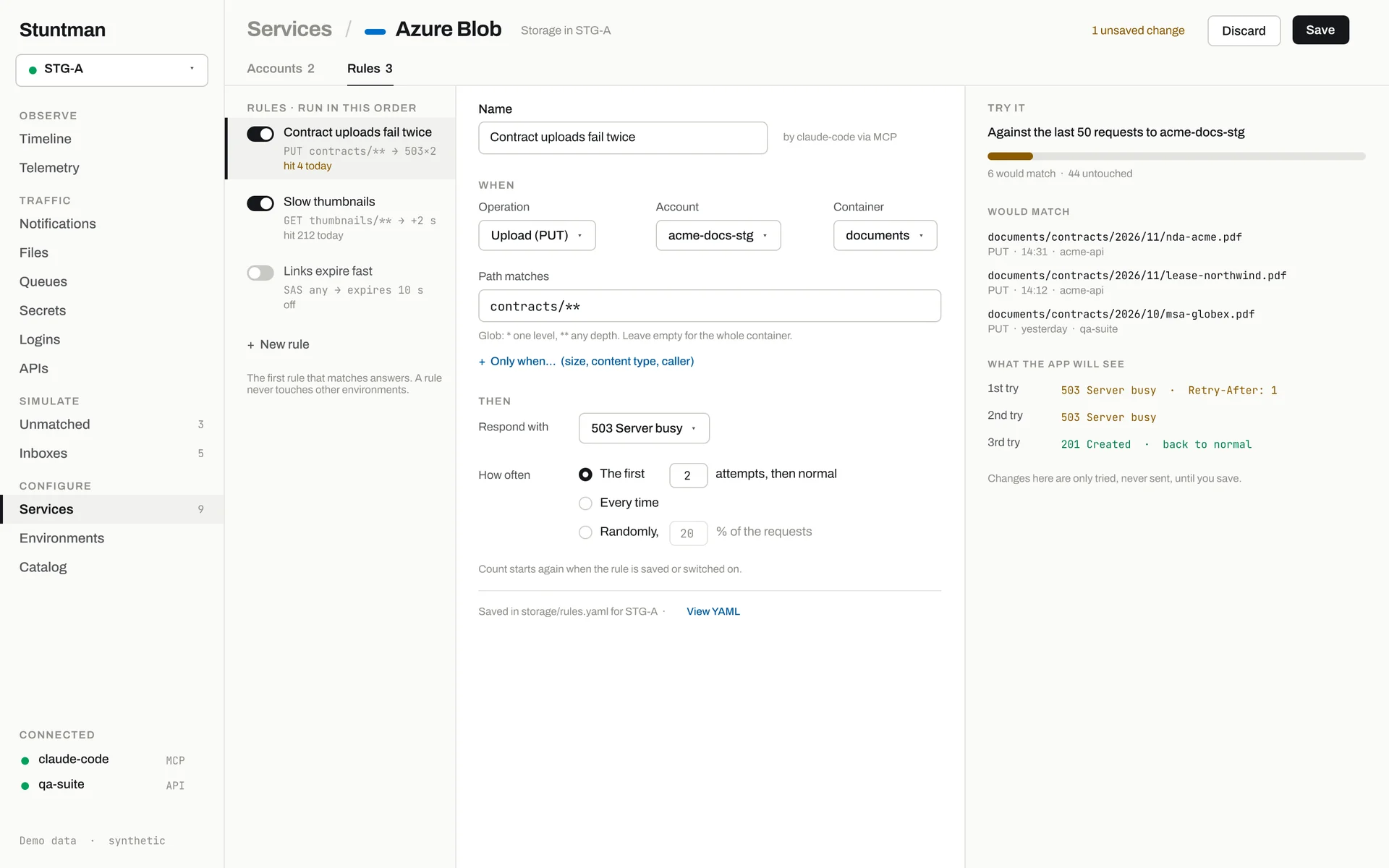
The storage rule “Contract uploads fail twice,” turned on by claude-code via MCP
1The rule, turned on by the agent

claude-code created it over MCP: the next two uploads to contracts/** answer 503, then the provider behaves again.
2It reads what your app actually did.

Not what the code says it does. Every call your app made is on the timeline, in the provider's words.

wait_for_object{"container": "documents", "prefix": "contracts/nda-acme"}
→ 408: no new object
agent

Nothing was stored. The timeline shows two 503s, then acme-api gave up. The retry limit is the bug.

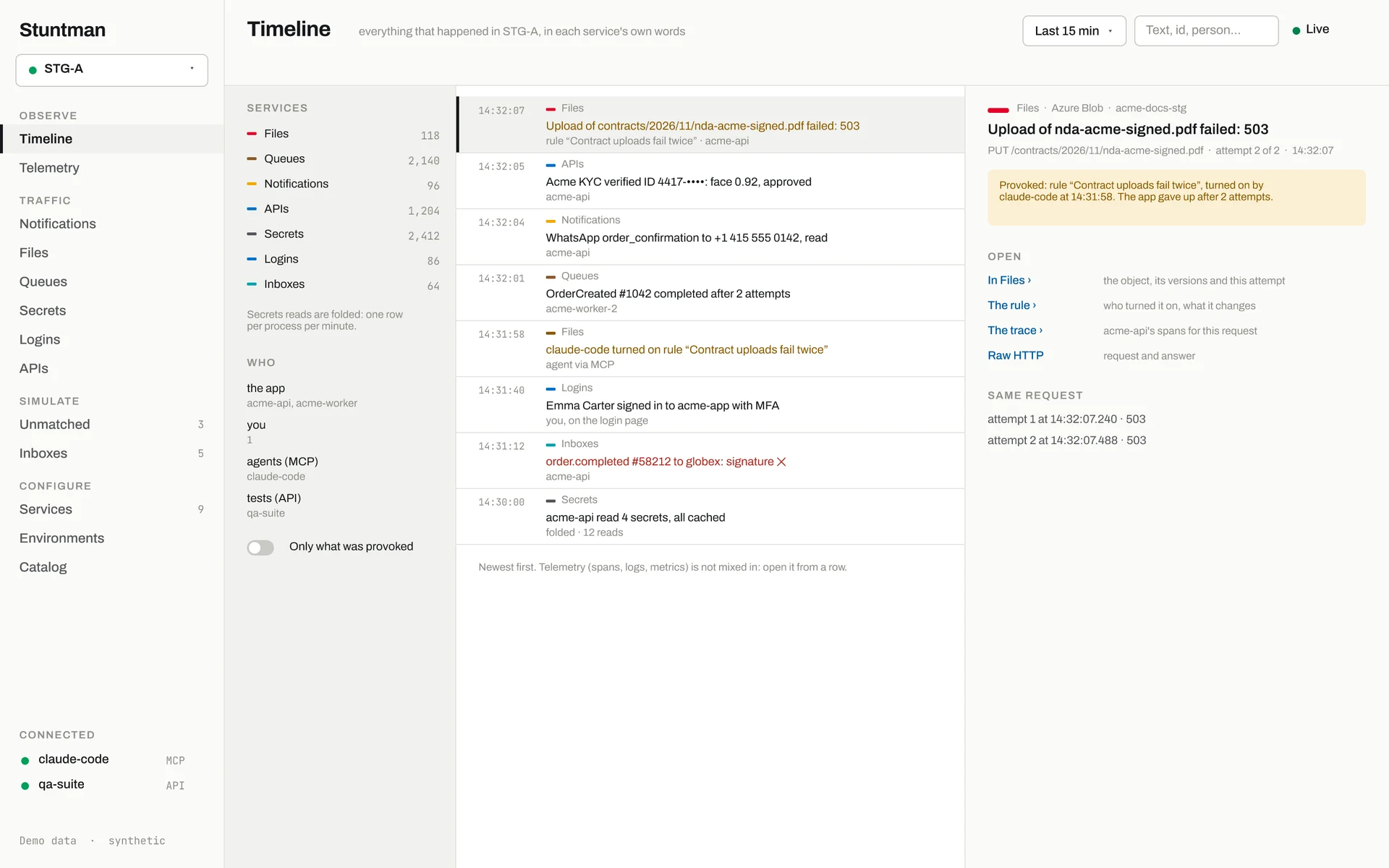
The timeline: the upload of nda-acme-signed.pdf failed with 503, provoked by the rule; attempt 1 and 2 both 503
2What the app really did

Attempts 1 and 2 both got the 503 the rule provoked, and then acme-api gave up: the retry limit is the bug.

3It fixes the code and runs the flow again.

The rule is still on, so the second run meets the same two failures. This time the app has to get through them.

agent

Raised the upload attempts in BlobUploader from 2 to 3, with backoff. Running the signing flow again.

wait_for_object{"container": "documents", "prefix": "contracts/nda-acme"}
→ nda-acme-signed.pdf stored, on the third attempt
set_rule_enabled{"name": "Contract uploads fail twice", "enabled": false}
→ rule off
agent

The fix holds: the third attempt stored the file. I turned the rule off. The calls are on the timeline under my name.

4You check the evidence, not the agent's word.

The rule shows who turned it on, which requests it matched and what the app gets on each try. Nothing rests on the agent's summary.

The rule: turned on by claude-code via MCP; what the app gets: 503, 503, then 201

One prompt. The whole app tested.

You ask once. The agent sets up, provokes, reads and checks every provider path, then hands back a report you can verify in the UI.

you

Test sign-up end to end against Stuntman: SMS down, a WhatsApp reply, an email bounce, login with MFA. Fix what breaks.

The agent's run: set up, SMS down, WhatsApp reply, email bounce, login with MFA, avatar upload failed on retry limit 2, fix, avatar upload stored on attempt 3, check: no calls to real providers

Any agent. Same switches.

Anything that speaks MCP, or plain HTTP, drives Stuntman the way a person does in the UI. Every MCP tool is also an HTTP route; GET /api/tools lists them all.

Claude Code, Codex, Gemini CLI, OpenCode, Cursor and GitHub Copilot, each a line through MCP or HTTP into Stuntman

Over MCP

create_rule {"service": "azure-blob", "name": "Contract uploads fail twice",
  "when": {"op": "put", "path": "contracts/**"},
  "then": {"respond": "503"}, "how_often": {"first": 2}}

Over HTTP

POST /api/services/azure-blob/rules
{"name": "Contract uploads fail twice",
 "when": {"op": "put", "path": "contracts/**"},
 "then": {"respond": "503"}, "how_often": {"first": 2}}

No plugin for your provider yet? Ask.

A provider is one YAML file: routes, state, answers, callbacks and the sentence each call leaves. The tools that read a plugin can also write it, so the agent drafts it and you review it in the UI, with the YAML beside it.

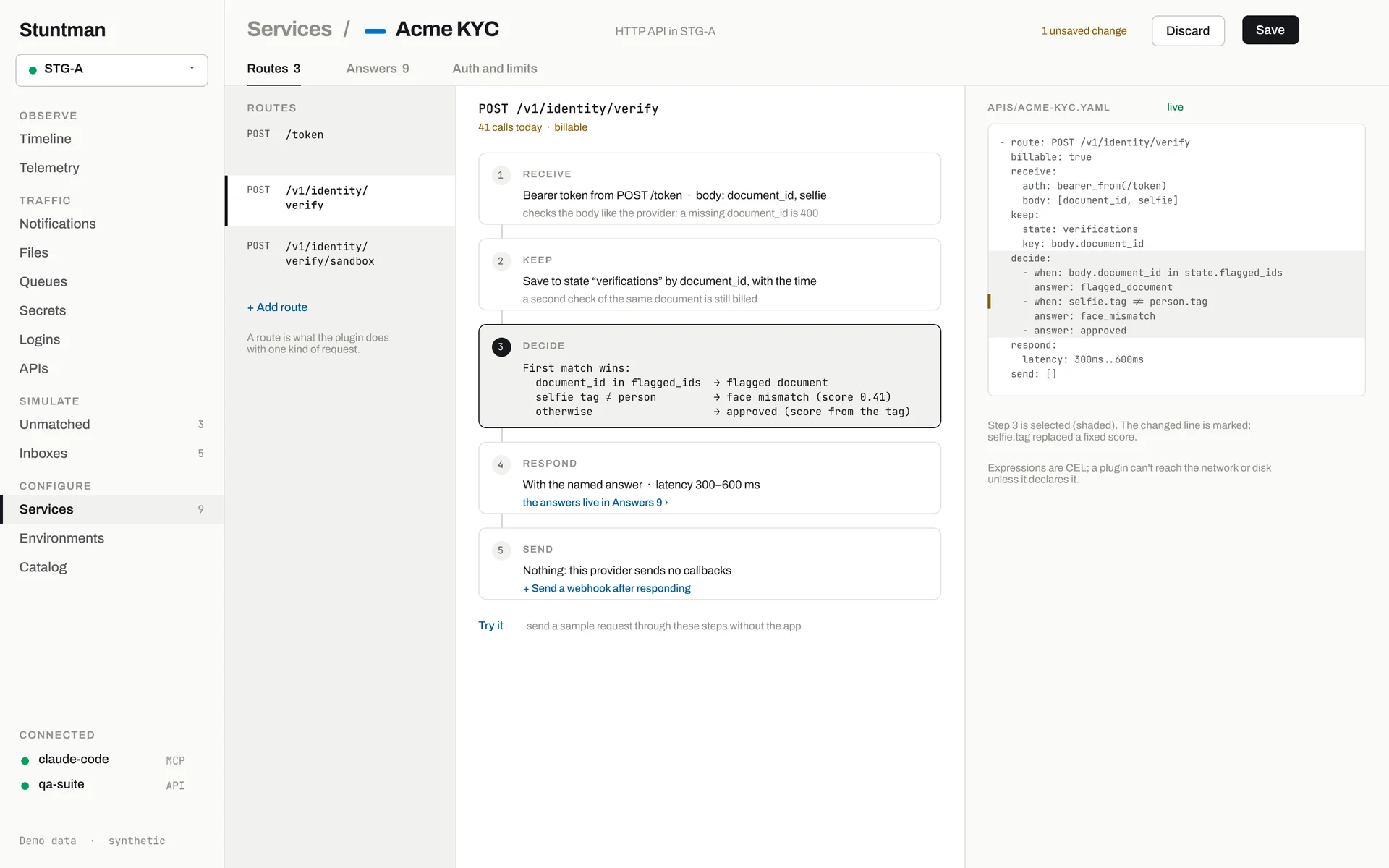
The route editor: receive, keep, decide, respond, send, with the plugin YAML beside it
What does my app point at?
Its provider base URLs. Stuntman answers on them with the provider's own paths, bodies and status codes.
Can each pull request get its own?
Yes. A pipeline clones stg-a into pr-5462 for its agent, and the copy expires by itself.
Is it safe to expose?
Turn sign-in on first: any OIDC provider and a list of people, an admin key for pipelines and a token per environment. The app's provider routes stay open. Without it, keep Stuntman on a private network.