Everything Service Bus and RabbitMQ gives you
- 01
Every message, every delivery
Published, delivered, abandoned, completed or dead-lettered: each message keeps its history and properties.
- 02
Queues, topics, subscriptions
Namespaces with queues and topics; Service Bus subscriptions or RabbitMQ bindings fan out what is published.
- 03
Consumers and their locks
Who is receiving, receive mode, prefetch, the locks held now and what each consumer completed today.
- 04
Rules for deliveries
When op, entity and subject match: lose the lock, duplicate, hold, drop or dead-letter, the first N or a share.
- 05
Dead-letter and resubmit
See why a message was dead-lettered, move one there by hand, or put them all back on their queue.
- 06
Publish as a partner
publish puts a message on a queue or topic with subject, properties, session or schedule; it is marked as yours.
- 07
RabbitMQ management API
MassTransit and provisioning scripts create vhosts, queues, exchanges and bindings on :15672 before they connect.
- 08
Namespace-wide trouble
Refuse connections, time out, reject the key, answer ServerBusy, cap the throughput or turn off auto-create.
The screens
Each number is a control or a reading on the real screen. Everything you can click there, your agent can do with a tool.
Messages with their delivery history
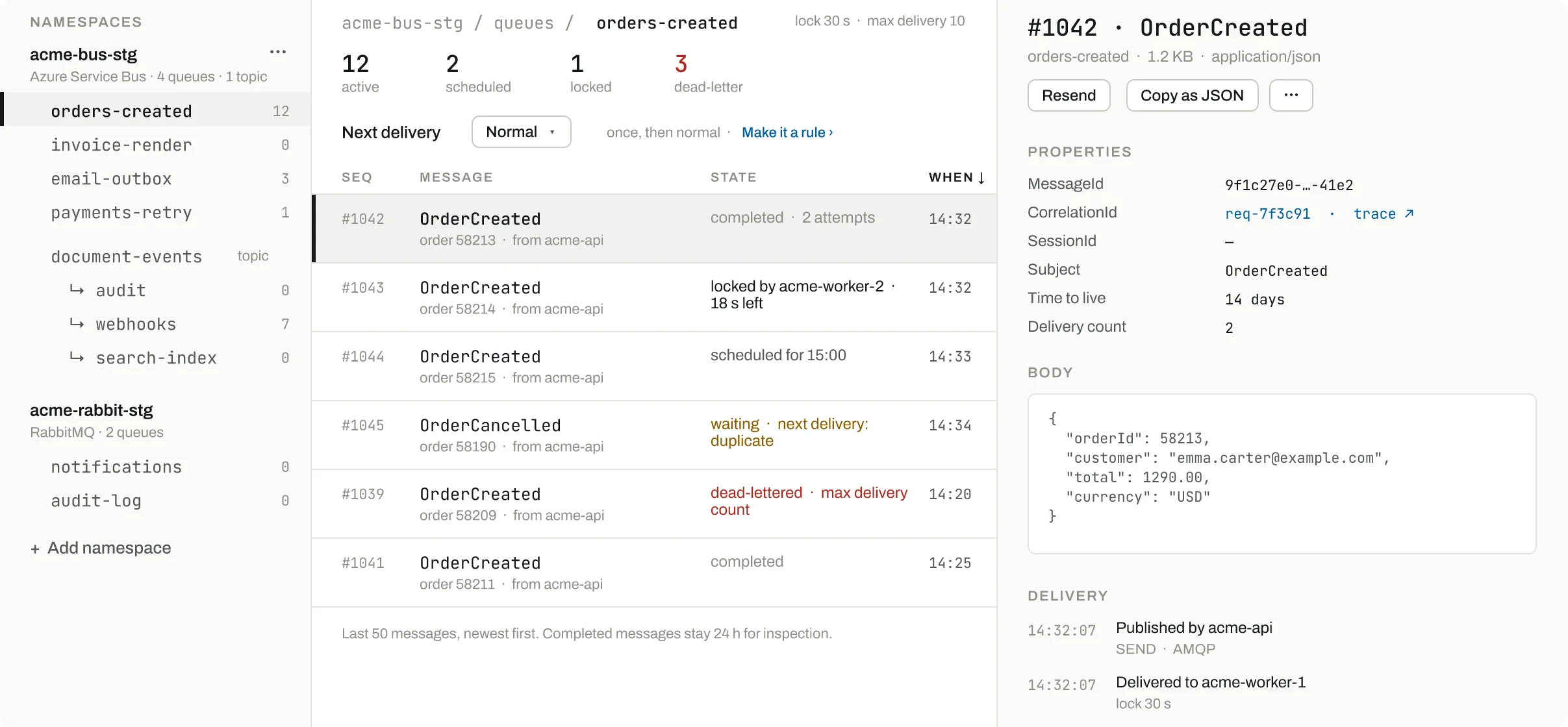
Service Bus and RabbitMQ namespaces side by side, with queues, topics and subscriptions.
Active, scheduled, locked and dead-letter for the entity.
Lose the lock, duplicate, hold, drop or dead-letter the next delivery, once.
Which consumer holds the lock and how long it has left.
Published, delivered, abandoned with the handler's error, then completed on attempt 2.
- Both brokers
Service Bus and RabbitMQ namespaces side by side, with queues, topics and subscriptions.
- Counts by state
Active, scheduled, locked and dead-letter for the entity.
- Next delivery
Lose the lock, duplicate, hold, drop or dead-letter the next delivery, once.
- Locked
Which consumer holds the lock and how long it has left.
- Delivery history
Published, delivered, abandoned with the handler's error, then completed on attempt 2.
Consumers, and how to knock them over
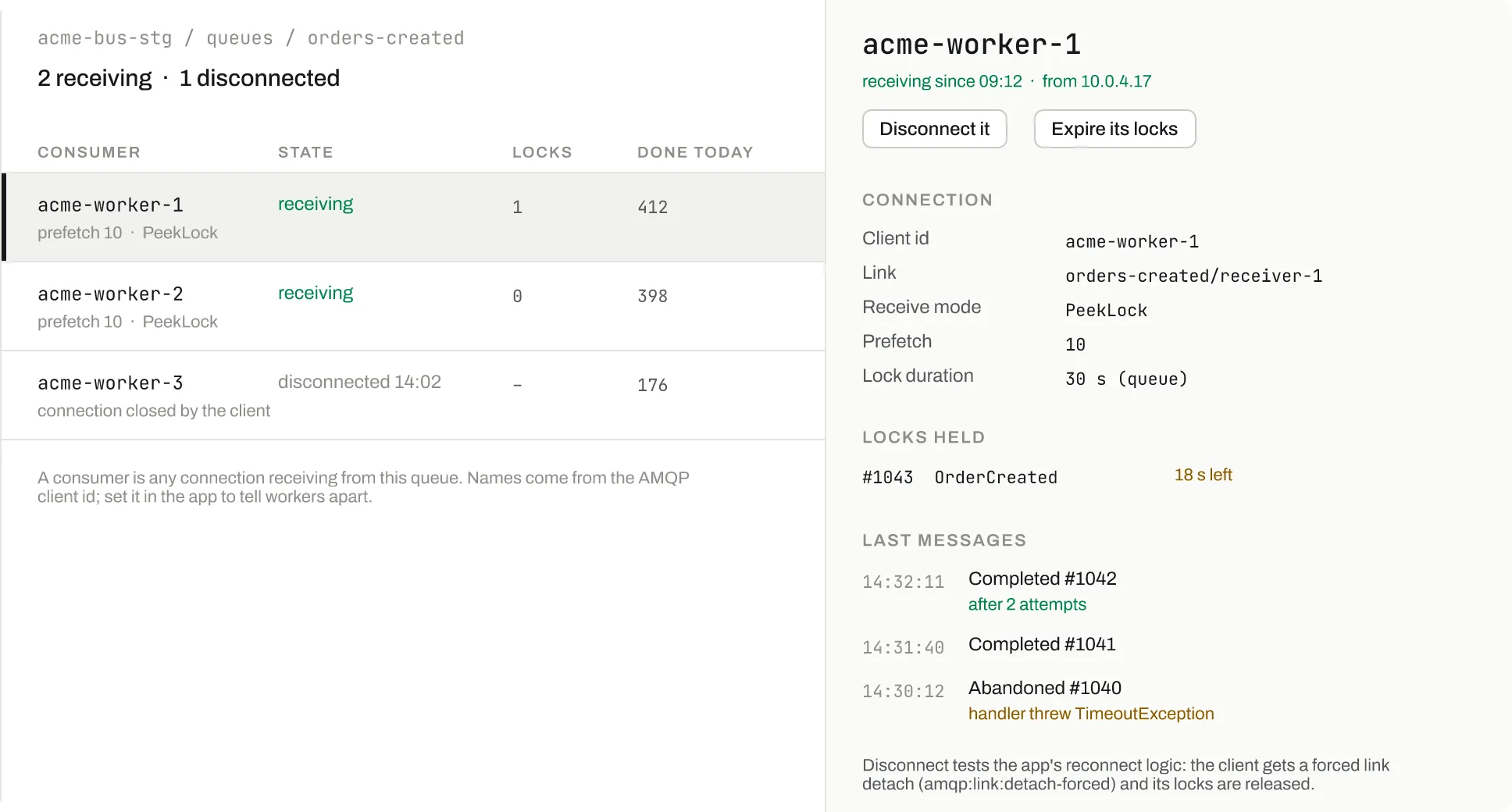
Each connection with prefetch and receive mode; names come from the AMQP client id.
Consumers that left in the last day, and why.
A forced detach (or CONNECTION_FORCED on RabbitMQ) tests the app's reconnect logic.
Its next complete fails with MessageLockLost and the messages come again.
The messages this consumer has locked and the time left on each.
- Receiving now
Each connection with prefetch and receive mode; names come from the AMQP client id.
- Disconnected
Consumers that left in the last day, and why.
- Disconnect it
A forced detach (or CONNECTION_FORCED on RabbitMQ) tests the app's reconnect logic.
- Expire its locks
Its next complete fails with MessageLockLost and the messages come again.
- Locks held
The messages this consumer has locked and the time left on each.
A rule, tried on real traffic before you save
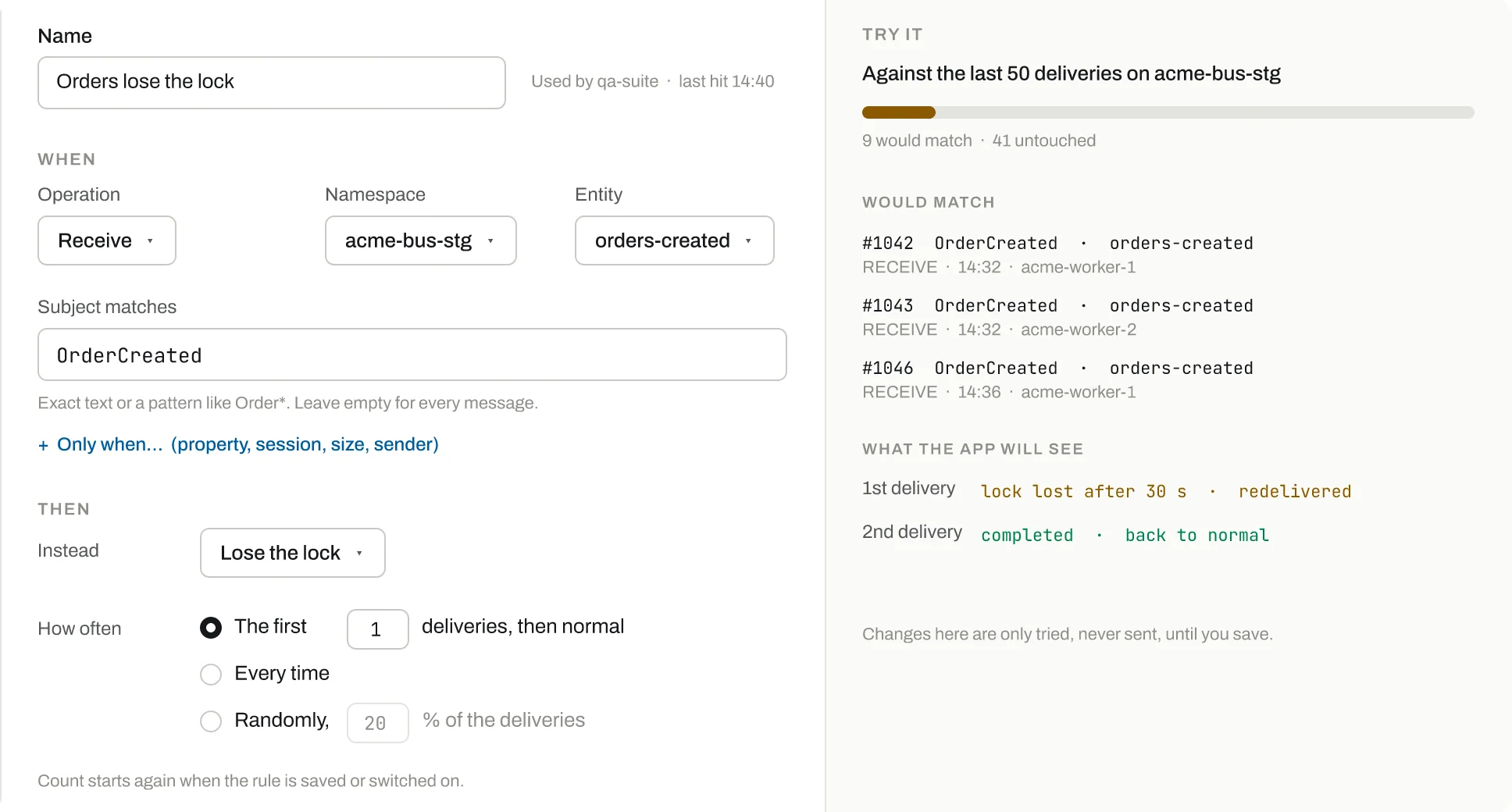
Operation, namespace, entity and subject; more conditions on properties, session, size or sender.
What happens to the matching delivery: here the lock is lost and the message comes again.
The first N, every time, or a random share of deliveries.
How many of the last 50 deliveries would match, and which ones.
Lock lost after 30 s and redelivered, then back to normal.
- When
Operation, namespace, entity and subject; more conditions on properties, session, size or sender.
- Instead
What happens to the matching delivery: here the lock is lost and the message comes again.
- How often
The first N, every time, or a random share of deliveries.
- Try it
How many of the last 50 deliveries would match, and which ones.
- What the app will see
Lock lost after 30 s and redelivered, then back to normal.
Break it on purpose
The failures you need to test, exactly when you ask: from the screen or by a tool call, each one shown on the timeline with who caused it.
Lost lockThe next delivery loses its lock and comes again
set_next_delivery {behavior: lose_lock}Duplicate deliveryThe same message is delivered twice
set_next_delivery {behavior: duplicate}Held, dropped or out of orderDelivery waits 30 s, never comes, or overtakes another
set_next_delivery hold | drop | out_of_orderDead-lettered on arrivalThe message goes straight to the dead-letter queue
set_next_delivery {behavior: dead_letter}MessageLockLost on completeLocks a consumer holds expire now
expire_consumer_locksForced disconnectamqp:link:detach-forced or CONNECTION_FORCED
disconnect_consumerNamespace downConnections refused, time out, 401 or ServerBusy
set_namespace_reachabilityThrottledServerBusy over N messages a second, or every send
set_throughputRotated keySenders still on the old key get 401
rotate_policy_keyMissing entityQueues the app did not declare answer 404
set_auto_create {on: false}Rule on deliveriesAny of the above for matching messages, first N or a share
create_rule {service: azure-service-bus}
Why not the real sandbox
No cloud namespace
No Azure subscription, no RabbitMQ container: one process speaks both, with the same connection strings.
See inside the broker
Every delivery, lock and consumer is visible, which a real broker only gives through metrics.
Hard cases on cue
Lost locks, duplicates and forced detaches happen on the next delivery instead of once a month in production.
Rules tried first
A rule shows which recent deliveries it would hit before you save it, and never touches other environments.
Your AI agent drives it
Claude Code, Codex or any MCP client connects to /mcp (or calls /api over plain HTTP), sets the stand-in up, breaks it on cue and reads what your app did.
Make sure the order worker handles a lost lock without processing the order twice.
MCP tools
list_namespacesNamespaces, entities, counts per state, connection stringlist_queue_messagesMessages of a queue, topic or subscriptionget_queue_messageOne message with its delivery historypublishPublish a message as a testlist_consumersConnections receiving from an entityexpire_consumer_locksThe consumer's next complete fails with MessageLockLostset_namespace_reachabilityRefuse, time out, 401 or busyresubmitPut dead-lettered messages back on their queuecreate_ruleLose locks, duplicate, hold or drop matching deliveries
The same over HTTP
- GET
/api/messaging/namespaces - GET
/api/messaging/{namespace}/{entity}/messages - POST
/api/messaging/{namespace}/{entity}/messages - POST
/api/messaging/{namespace}/consumers/{id}/expire-locks - PUT
/api/messaging/{namespace}/reachability
- Service Bus finds the namespace by host name: give the environment a base domain under a wildcard DNS name.
- The management API's vhosts are the RabbitMQ namespaces of the default environment.