Everything ActiveMQ gives you
- 01
Every message, with its state
Scheduled, pending, delivered, acked, dead_letter, expired, rolled_back or discarded, with the redelivery count.
- 02
Local and XA transactions
Sends stay invisible until commit; rollback redelivers. XA prepare, two-phase commit and recover from any connection.
- 03
Durable subscriptions
A subscription name and client ID keep copies while the consumer is offline; a new topic or selector replaces it.
- 04
JMS selectors
The SQL-92 subset on headers and properties: IN, LIKE, BETWEEN, IS NULL, arithmetic. A bad one gets InvalidSelectorException.
- 05
Scheduler
AMQ_SCHEDULED_DELAY, PERIOD with REPEAT, and CRON on the environment's clock; BROWSE and REMOVE over JMS work too.
- 06
Dead letters as ActiveMQ does
Poisoned, past max_redeliveries or expired persistent messages go to ActiveMQ.DLQ, or one DLQ per destination.
- 07
Consumers like a real broker
Prefetch, pull, ack modes, browsers, noLocal, exclusive and priority consumers, wildcards and message groups.
- 08
Advisories
Connection, consumer, producer, destination, expired and DLQ advisories with the real payloads, while someone listens.
- 09
Wire format as asked
Loose or tight encoding, with or without the marshal cache, compressed bodies and blob messages.
The screens
Each number is a control or a reading on the real screen. Everything you can click there, your agent can do with a tool.
Messages and their states
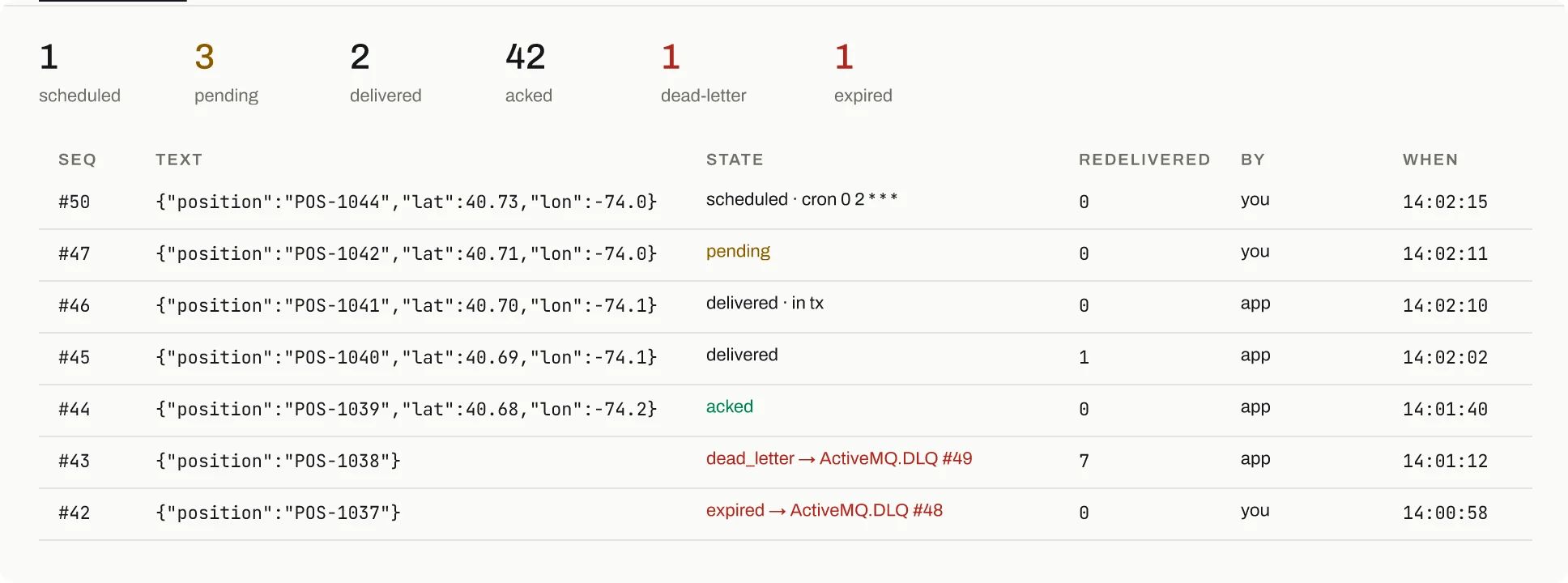
Scheduled, pending, delivered, acked, dead-letter and expired for the destination.
AMQ_SCHEDULED_CRON on the environment clock; advance_clock brings it forward.
Delivered in a transaction that is still open: the ack takes effect only on commit.
Redelivered 7 times, past max_redeliveries: the message went to the DLQ.
The original keeps its state and points at its copy in the dead-letter queue.
- Counts by state
Scheduled, pending, delivered, acked, dead-letter and expired for the destination.
- Scheduled by cron
AMQ_SCHEDULED_CRON on the environment clock; advance_clock brings it forward.
- Inside a transaction
Delivered in a transaction that is still open: the ack takes effect only on commit.
- Redelivery count
Redelivered 7 times, past max_redeliveries: the message went to the DLQ.
- Moved to ActiveMQ.DLQ
The original keeps its state and points at its copy in the dead-letter queue.
Send as the partner, then break the broker
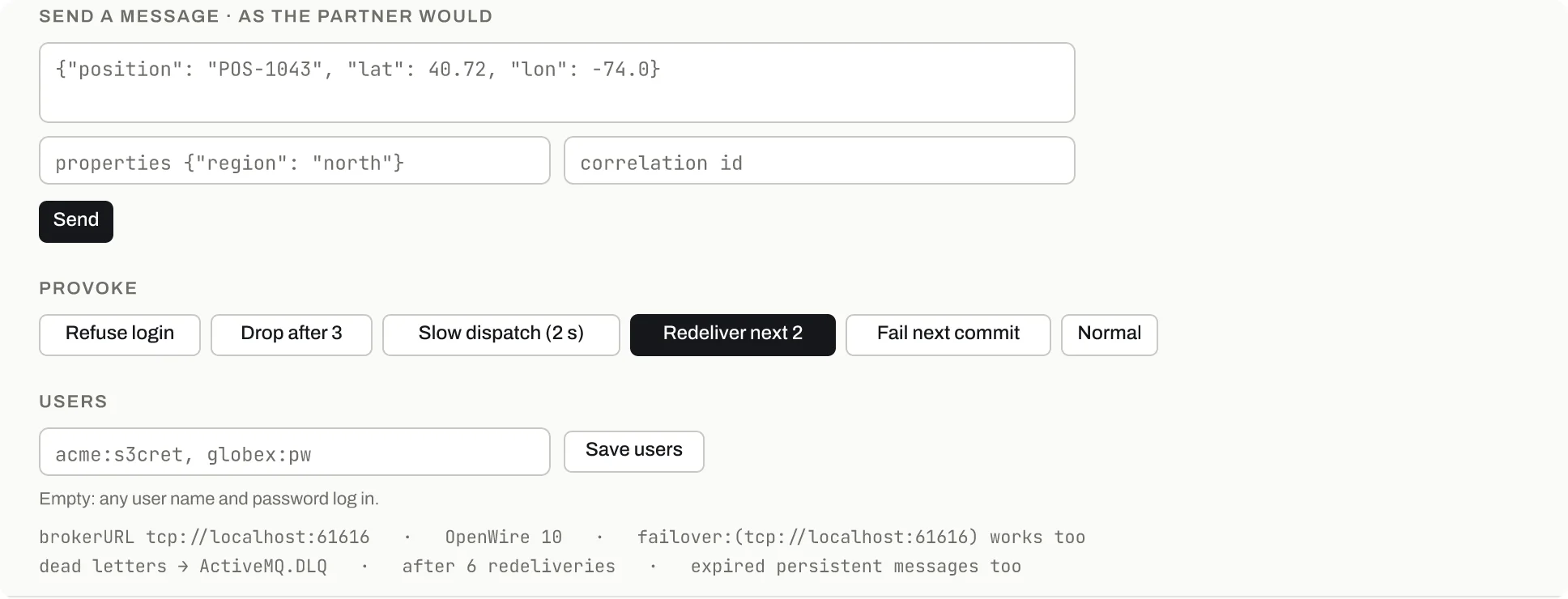
Text, properties and correlation id, dispatched to the app's consumers as the partner would.
Every login fails with a SecurityException.
The next 2 acks are lost; those messages come again with a higher redelivery count.
The commit fails with TransactionRolledBackException, or an XAException for XA.
User names and passwords; empty lets anyone log in.
- Send a message
Text, properties and correlation id, dispatched to the app's consumers as the partner would.
- Refuse login
Every login fails with a SecurityException.
- Redeliver next 2
The next 2 acks are lost; those messages come again with a higher redelivery count.
- Fail next commit
The commit fails with TransactionRolledBackException, or an XAException for XA.
- Users
User names and passwords; empty lets anyone log in.
Consumers, durable subscriptions, transactions
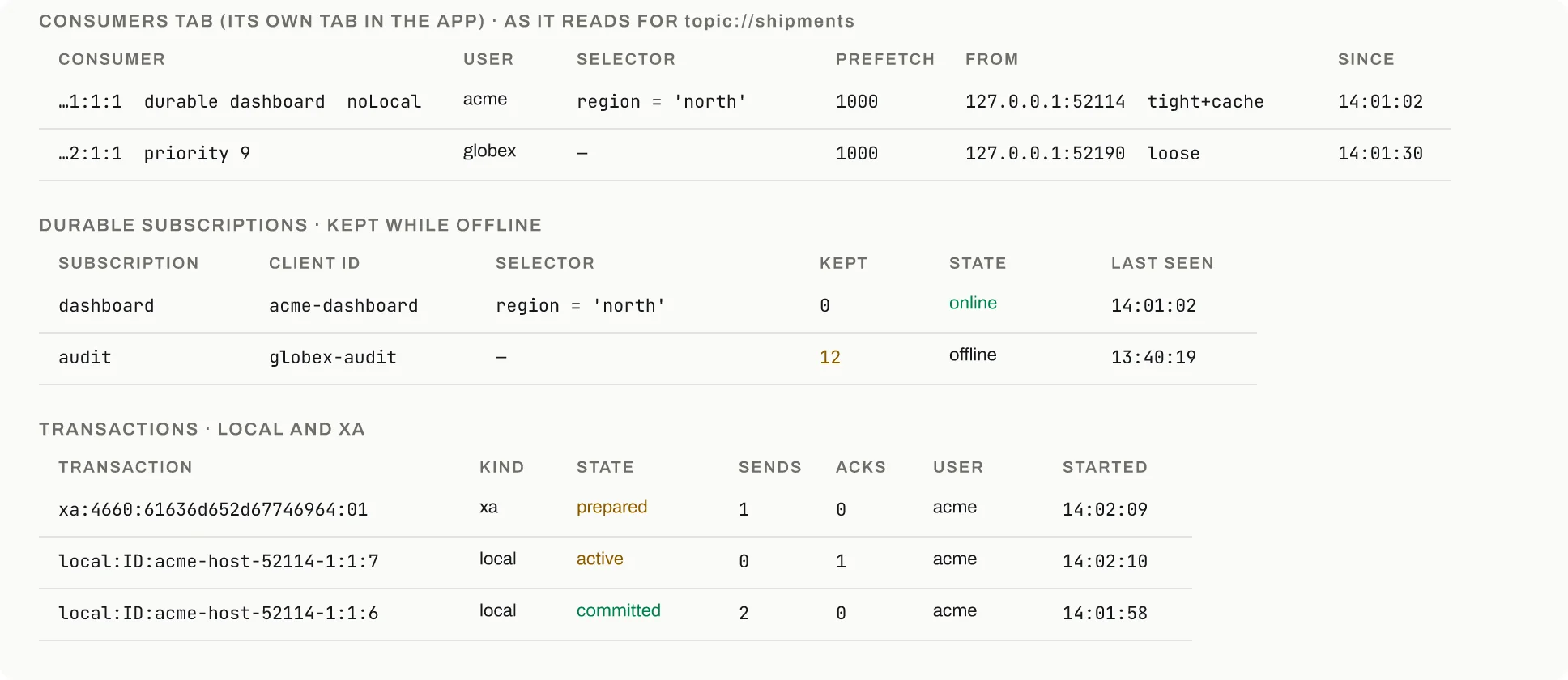
The consumer only gets messages whose properties match region = 'north'.
What the client negotiated: tight encoding with the marshal cache, or loose.
A durable subscription holds 12 messages until its client comes back.
Phase one done; recover lists it from any connection until commit or rollback.
Local transactions with their sends and acks.
- Selector
The consumer only gets messages whose properties match region = 'north'.
- Wire format
What the client negotiated: tight encoding with the marshal cache, or loose.
- Kept while offline
A durable subscription holds 12 messages until its client comes back.
- Prepared XA
Phase one done; recover lists it from any connection until commit or rollback.
- Committed
Local transactions with their sends and acks.
Break it on purpose
The failures you need to test, exactly when you ask: from the screen or by a tool call, each one shown on the timeline with who caused it.
Login refusedEvery login fails with a SecurityException
set_activemq {refuse_login: true}Connection droppedThe broker closes the connection after N dispatched messages
set_activemq {drop_after: 3}Slow dispatchA delay before each dispatch
set_activemq {slow_dispatch: "2s"}Lost acksThe next N acks are lost; those messages come again
set_activemq {redeliver: 2}Commit failsThe next N commits fail and roll back (XAException for XA)
set_activemq {fail_commits: 1}Fast dead-letteringMessages go to the DLQ after fewer redeliveries
set_activemq {max_redeliveries: 2}One DLQ per destinationActiveMQ.DLQ.Queue.<name> instead of ActiveMQ.DLQ
set_activemq {individual_dlq: true}Expired messageJMSExpiration passes; persistent ones go to the DLQ
activemq_send {ttl: "1m"} + advance_clockScheduled job cancelledA delayed, repeating or cron message never goes out
cancel_activemq_scheduled
Why not the real sandbox
No broker to run
No JVM, no activemq.xml: the app connects to 61616 and gets OpenWire 10 as NMS and the Java client expect.
See every message's state
Pending, delivered, in a transaction, rolled back or dead-lettered, which the web console never shows in one place.
Failures in the middle
A failed commit, a lost ack or a dropped connection after N messages, exactly where retries break.
Time you control
Scheduled, cron and expiring messages follow the environment clock, so a nightly job runs in a second.
Your AI agent drives it
Claude Code, Codex or any MCP client connects to /mcp (or calls /api over plain HTTP), sets the stand-in up, breaks it on cue and reads what your app did.
Check that our position consumer rolls back cleanly when a commit fails.
MCP tools
list_activemq_destinationsQueues, topics, consumers, durable subscriptions, transactionslist_activemq_messagesMessages newest first, with their stateactivemq_sendSend as the partner: properties, priority, delay, ttl, cronset_activemqUsers and broker behaviour: refuse, drop, redeliver, fail commitscancel_activemq_scheduledCancel scheduled messages before they go outwait_for_activemq_ackWait until the app ackedadvance_clockMove the environment's clock: scheduled and expiring messages follow
The same over HTTP
- GET
/api/activemq/destinations - GET
/api/activemq/messages - POST
/api/activemq/messages - PUT
/api/activemq/settings - GET
/api/activemq/wait-ack
- One port serves every environment: the default one answers.
- Not made: network-of-brokers and memory-limit advisories (TempQueue, SlowConsumer, FULL).