Everything Storage gives you
- 01
Objects with their history
Accounts, containers, block and multipart uploads. Each object shows versions, metadata and who wrote it: the app, you, the seed or an agent.
- 02
Wait for the upload
wait_for_object returns the first new object under a prefix, so a test acts in the app and then waits for the file instead of sleeping.
- 03
Rules per operation
When put, get, delete, list or link matches account, container and path glob: answer 503, 403, timeout or truncate. First N, every time or a share.
- 04
Try a rule first
test_rule replays the last requests and shows what each attempt would get, before anything is saved.
- 05
Links you can break
Every SAS or presigned URL is listed with what it allows, validity and uses. Make its next use expired, badly signed, IP-denied or gone.
- 06
Events like the cloud
BlobCreated and BlobDeleted in Event Grid or S3 format, to a webhook or a queue, with the Event Grid validation handshake first.
- 07
Break event delivery
Hold, duplicate, reorder, drop or strip a field from the next event, then resend it to check the app's handler is idempotent.
- 08
Keys and reachability
rotate_key makes apps that sign with the old key get 403. set_account_reachability makes the whole account time out, 503 or 401.
- 09
Back to the seed
reset_to_seed puts every account back to its seed folder and says what changed since it was loaded.
The screens
Each number is a control or a reading on the real screen. Everything you can click there, your agent can do with a tool.
Objects, the next read and the history
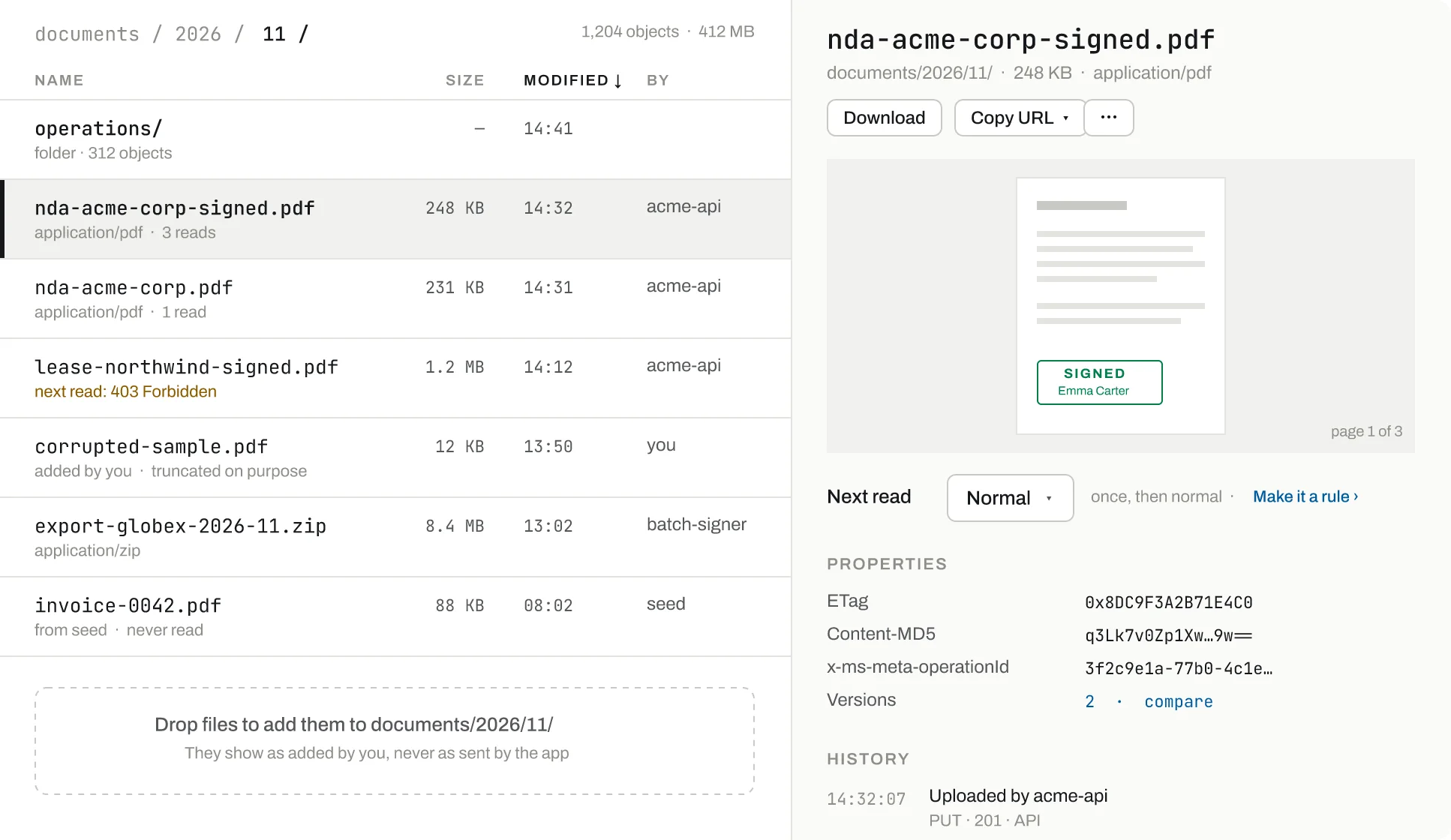
Uploaded by acme-api over the real Blob API: size, type, reads and who wrote it.
set_next_read makes the next read answer 403, 404, 503, slow, truncated or with a bad MD5.
put_object can store a truncated file on purpose; it is never shown as sent by the app.
Normal by default; pick a failure once, then it goes back to normal by itself.
Every version is kept, with ETag and Content-MD5, so you can compare what the app overwrote.
- Written by the app
Uploaded by acme-api over the real Blob API: size, type, reads and who wrote it.
- A read armed to fail
set_next_read makes the next read answer 403, 404, 503, slow, truncated or with a bad MD5.
- Added by you
put_object can store a truncated file on purpose; it is never shown as sent by the app.
- Next read, per object
Normal by default; pick a failure once, then it goes back to normal by itself.
- Versions
Every version is kept, with ETag and Content-MD5, so you can compare what the app overwrote.
A rule, tried before it is saved
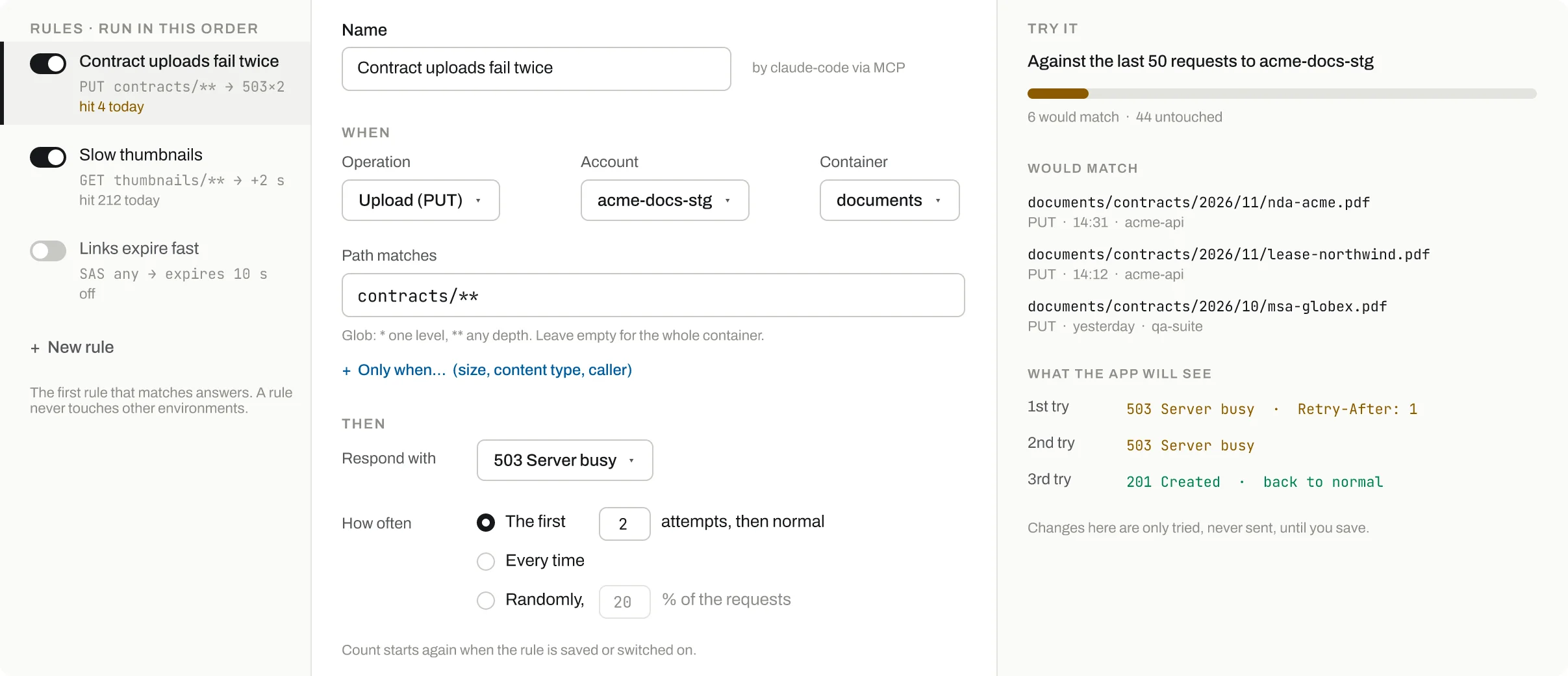
The first rule that matches answers. Each shows its hits today and switches off with one click.
Operation, account, container and a glob: * is one level, ** any depth.
503, 403, 404, 409, 412, 413, timeout, reset, empty, slow, truncate or bad_md5.
The first N attempts, every time, or a random share of the requests.
Each attempt against the last 50 real requests: 503, 503, then 201.
- Rules in order
The first rule that matches answers. Each shows its hits today and switches off with one click.
- Path glob
Operation, account, container and a glob: * is one level, ** any depth.
- The answer
503, 403, 404, 409, 412, 413, timeout, reset, empty, slow, truncate or bad_md5.
- How often
The first N attempts, every time, or a random share of the requests.
- What the app will see
Each attempt against the last 50 real requests: 503, 503, then 201.
Every SAS and presigned link
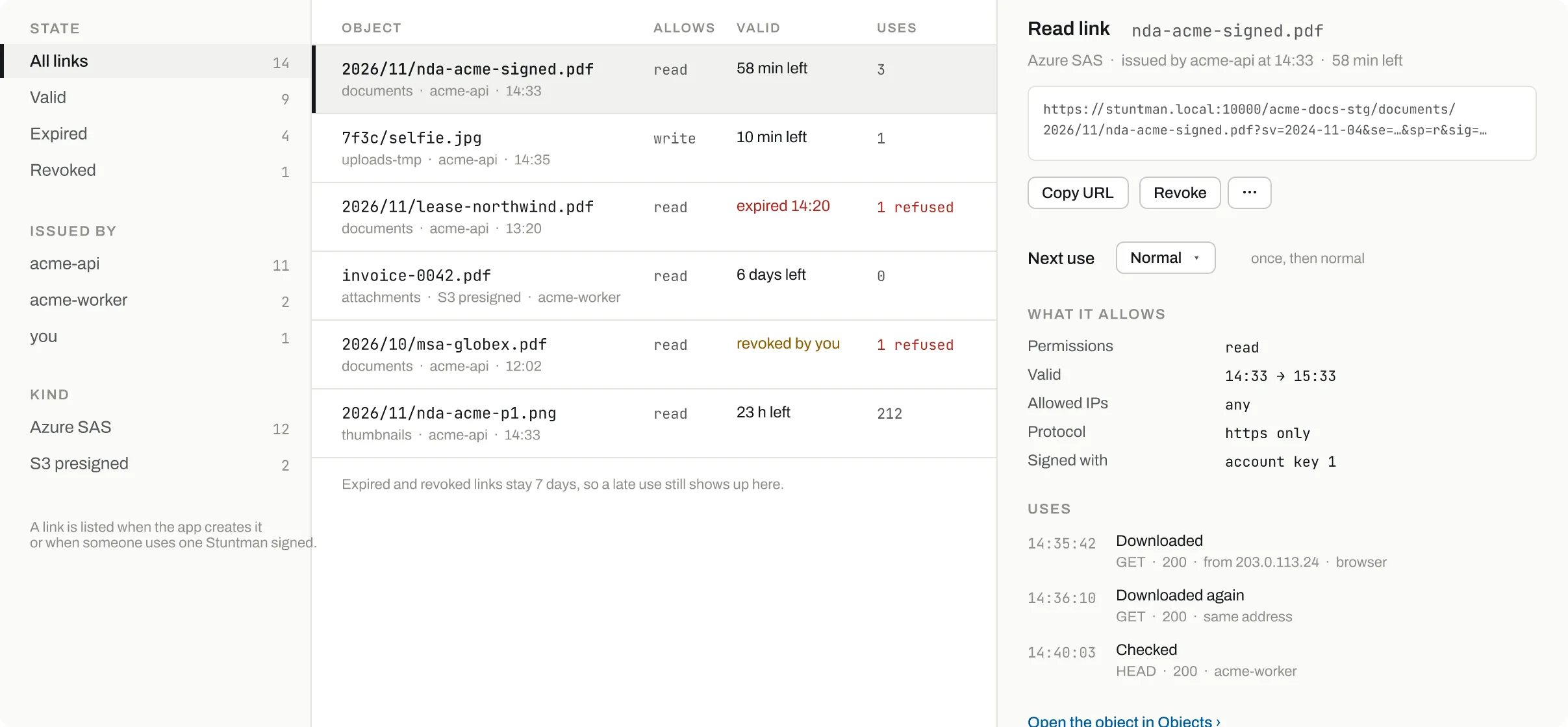
Valid, expired or revoked; filter by who issued the link and by kind (Azure SAS or S3 presigned).
A late use of an expired link still shows up, with the answer the app's user got.
revoke_link: the next use answers 403 AuthenticationFailed, like Azure after a key rotation.
set_next_use: expired, bad_signature, ip_denied, permission, not_yet_valid or gone.
Each download with method, status and address, so you see who used the link and when.
- By state
Valid, expired or revoked; filter by who issued the link and by kind (Azure SAS or S3 presigned).
- Refused uses
A late use of an expired link still shows up, with the answer the app's user got.
- Revoked
revoke_link: the next use answers 403 AuthenticationFailed, like Azure after a key rotation.
- Next use
set_next_use: expired, bad_signature, ip_denied, permission, not_yet_valid or gone.
- Uses
Each download with method, status and address, so you see who used the link and when.
Break it on purpose
The failures you need to test, exactly when you ask: from the screen or by a tool call, each one shown on the timeline with who caused it.
Uploads fail twice503 on the first 2 PUTs to contracts/**, then 201
create_rule with how_often {"first": 2}Reads fail at randomA share of GETs answer 503 or time out
create_rule with how_often {"random": 25}One bad readThe next read is 403, 404, 503, slow, truncated or bad MD5
set_next_readLink expired earlyThe next use of a link answers as expired or badly signed
set_next_useLink revoked403 AuthenticationFailed; the app is not told
revoke_linkOld keyApps signing with the previous key get 403
rotate_keyAccount downThe whole account times out, answers 503 or 401
set_account_reachabilityEvent duplicatedThe next BlobCreated arrives twice
set_next_delivery duplicateEvents out of orderReorder, hold for 30 s or drop the next event
set_next_delivery reorder | hold:30s | dropEvent missing a fieldThe payload lacks a field the handler expects
set_next_delivery missing_field
Why not the real sandbox
Failures the cloud won't give
Azure and S3 do not fail on demand. Here a 503 on the second upload, a truncated read or a late event happens on the next call.
Links you can inspect
Every SAS and presigned URL the app makes is listed with its uses and refusals, which the real portal never shows.
No account, no bill
No subscription, no keys to protect and no egress cost. Each environment has its own accounts and resets to a seed.
Proof of who wrote what
Objects remember whether the app, a test, an agent or the seed wrote them, so a test can prove the app did the upload.
Your AI agent drives it
Claude Code, Codex or any MCP client connects to /mcp (or calls /api over plain HTTP), sets the stand-in up, breaks it on cue and reads what your app did.
Make the contract upload fail twice with 503 and check that the app retries and the object ends up in storage.
MCP tools
list_objectsObjects under a prefix, newest first, with who wrote themget_objectProperties, versions and history of one objectwait_for_objectWait for the first new object under a prefixset_next_readArm the next read: 403, 404, 503, slow, truncate, bad_md5create_ruleFail matching requests: first N, every time or a sharetest_ruleSee what a rule would do to recent trafficlist_linksSAS and presigned links with uses and refusalsset_next_useMake a link's next use expired, badly signed or goneset_next_deliveryHold, duplicate, reorder or drop the next eventwait_for_storage_deliveryWait for an event delivery and the app's answer
The same over HTTP
- GET
/api/storage/{account}/{container}/objects - GET
/api/storage/{account}/{container}/wait - PUT
/api/storage/{account}/{container}/next-read/{*path} - POST
/api/services/{name}/rules - PUT
/api/storage/links/{id}/next-use - GET
/api/storage/events/wait
- Blob on :10000, S3 on :9000; rules live in storage/rules/<service>.yaml per environment.