Everything HTTP APIs gives you
- 01
Routes as readable steps
Each route reads receive, let, keep, wait, decide, respond, send. Edit in the route editor or the YAML; every change is validated first.
- 02
State and data tables
keep stores what the provider remembers between calls; data tables (people, flagged documents) feed answers through lookup().
- 03
Auth like the provider
OAuth2 client credentials with a token route, Basic, session cookies from a login route, and mTLS client certificates.
- 04
Browser steps
Plugins draw authorize pages (PKCE, OTP, pick a person) and push approvals the app polls. Agents pass them with authorize_as and approve_push.
- 05
GraphQL and streams
Routes share POST /graphql and answer by operation name. Answers can stream as SSE, NDJSON or plain chunks.
- 06
Be an MCP server
An mcp: block serves tools/list and tools/call on /<service>/mcp; each tool decides like a route. set_mcp_tool adds one.
- 07
Signed webhooks
send steps sign as hex HMAC, Stripe, Svix, GitHub or CloudEvents. Delays follow the environment's clock: advance_clock(by="30d").
- 08
Idempotency and scenarios
A repeated Idempotency-Key replays the first answer (409 on another body). Scenarios switch a service's behaviour by name.
- 09
Catch unmatched calls
Requests no route takes are kept with the closest route; route_from_request drafts the missing route from one.
The screens
Each number is a control or a reading on the real screen. Everything you can click there, your agent can do with a tool.
A route, step by step, with its YAML
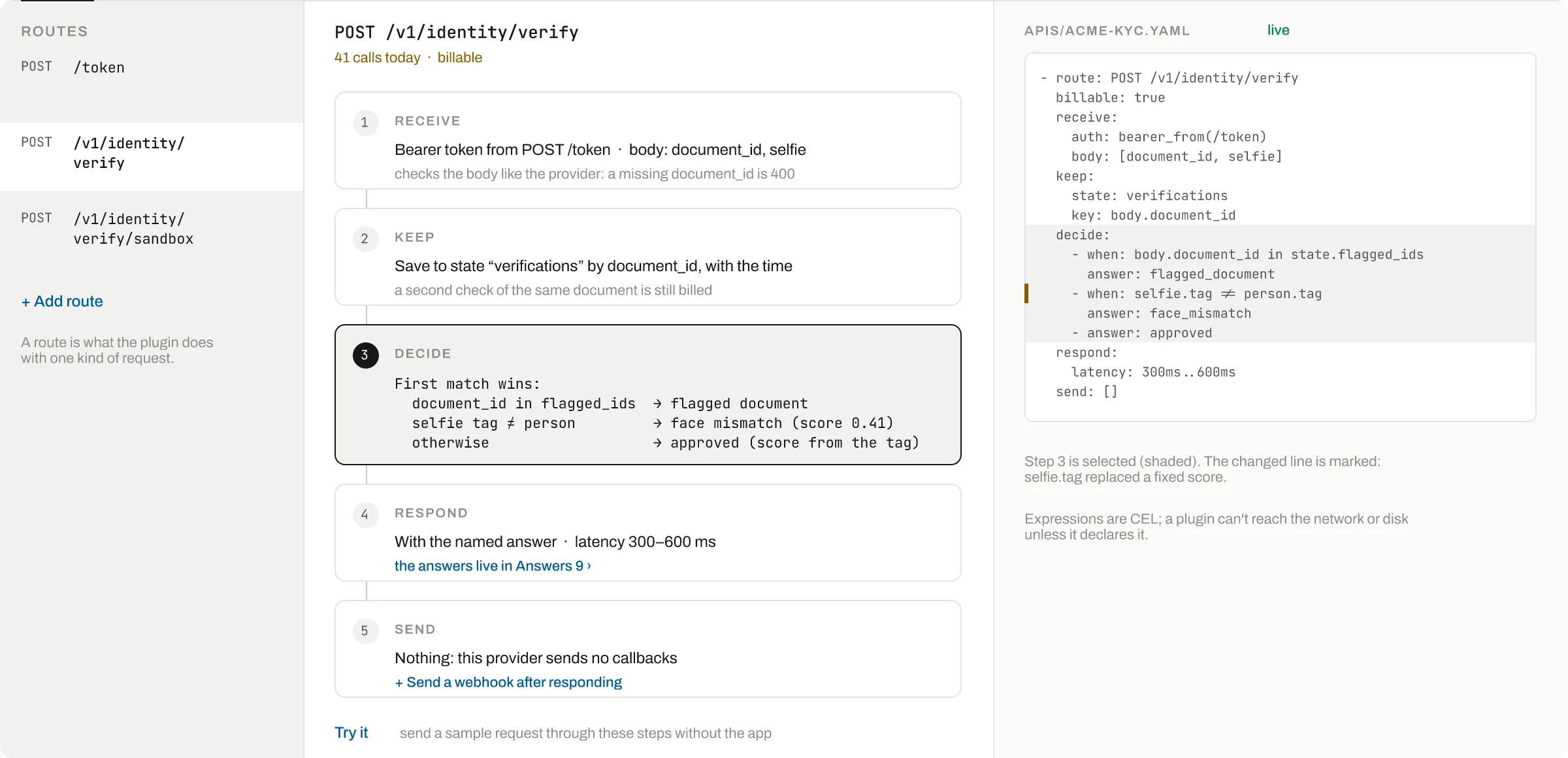
One route per kind of request the provider takes, with its calls today and billing.
Bearer token from the plugin's own token route; a missing body field answers 400 like the provider.
State the provider remembers between calls, keyed by an expression. Refused calls change nothing.
First match wins: conditions on body, state and data pick a named answer.
The YAML beside the editor marks the changed lines. Try it runs a sample request without keeping anything.
- Routes of the plugin
One route per kind of request the provider takes, with its calls today and billing.
- Receive
Bearer token from the plugin's own token route; a missing body field answers 400 like the provider.
- Keep
State the provider remembers between calls, keyed by an expression. Refused calls change nothing.
- Decide
First match wins: conditions on body, state and data pick a named answer.
- The same file
The YAML beside the editor marks the changed lines. Try it runs a sample request without keeping anything.
A browser step the plugin draws
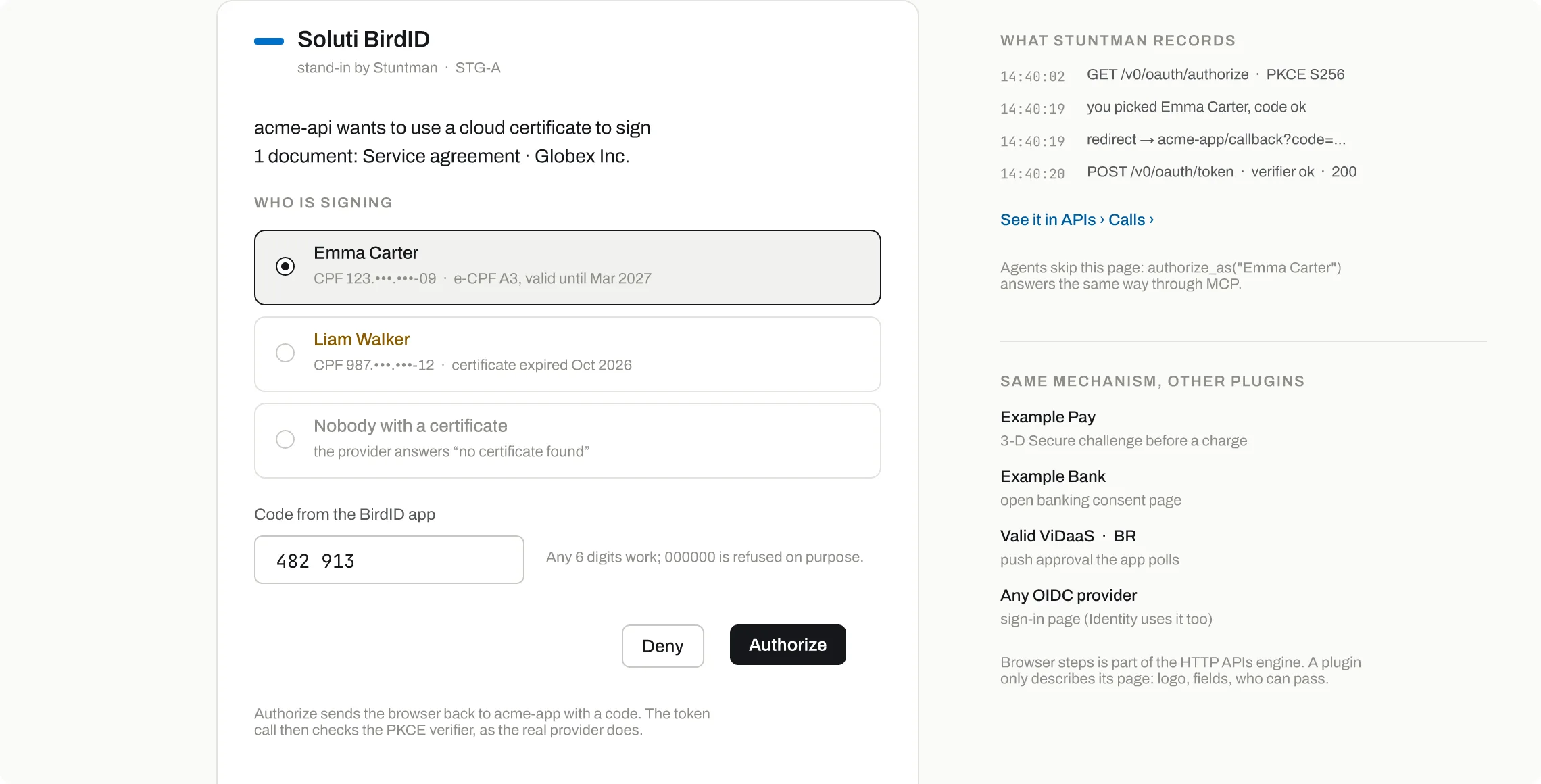
Synthetic people with their certificates come from the plugin's data table.
Pick a person whose certificate expired to see how the app handles it.
Any 6 digits pass; 000000 is refused on purpose.
Redirects to the app with code and state; the token call then checks the PKCE verifier.
Each step lands on the timeline. Agents skip the page with authorize_as.
- People from the plugin
Synthetic people with their certificates come from the plugin's data table.
- Broken on purpose
Pick a person whose certificate expired to see how the app handles it.
- One-time code
Any 6 digits pass; 000000 is refused on purpose.
- Authorize or Deny
Redirects to the app with code and state; the token call then checks the PKCE verifier.
- What Stuntman records
Each step lands on the timeline. Agents skip the page with authorize_as.
Webhook signing, idempotency and the clock
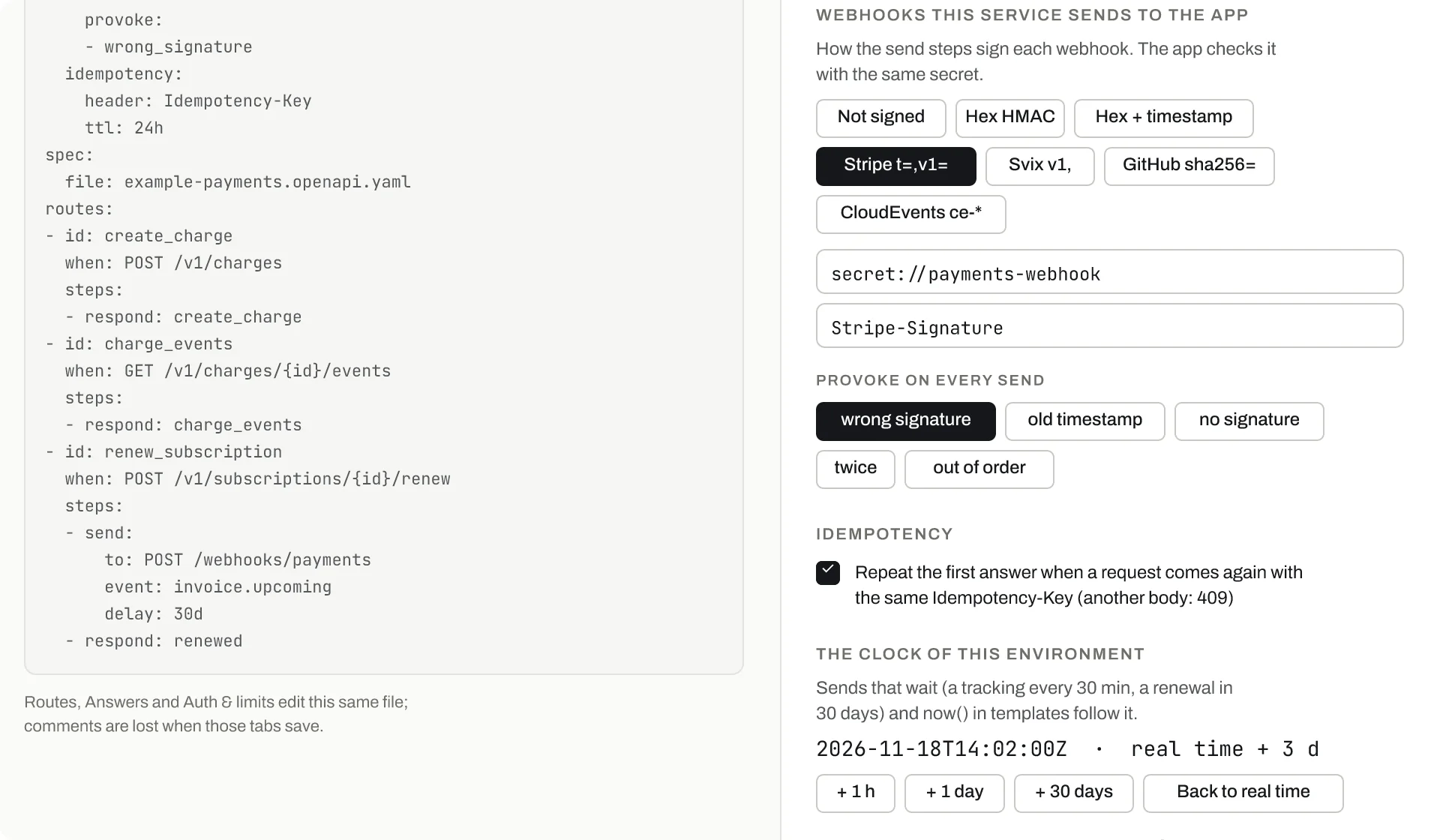
Hex HMAC, hex with timestamp, Stripe, Svix, GitHub or CloudEvents, with the secret and header the app checks.
Wrong signature, old timestamp, no signature, sent twice or out of order, until set back to none.
The same key gets the first answer again with no webhook; the same key with another body gets 409.
Move it 1 h, 1 day or 30 days: waiting webhooks go out and now() follows. Back to real time resets it.
- Sign like the provider
Hex HMAC, hex with timestamp, Stripe, Svix, GitHub or CloudEvents, with the secret and header the app checks.
- Break every send
Wrong signature, old timestamp, no signature, sent twice or out of order, until set back to none.
- Idempotency-Key
The same key gets the first answer again with no webhook; the same key with another body gets 409.
- The environment's clock
Move it 1 h, 1 day or 30 days: waiting webhooks go out and now() follows. Back to real time resets it.
Break it on purpose
The failures you need to test, exactly when you ask: from the screen or by a tool call, each one shown on the timeline with who caused it.
Any named answerThe next N calls (or the next 10 minutes) get a declined, expired or not-found answer
force_answer {answer, count | for, route}Network failuresConnection reset, empty reply or a timeout
force_answer reset | empty | timeoutServer errors500 or 503 from the provider
force_answer 500 | 503HTML error pageA 200 whose body is an HTML error page, as a proxy in front of the provider sends
force_answer htmlExpired tokensEvery token and session cookie becomes invalid; the next call gets 401
expire_tokensRate limitCalls above the rate get 429 with Retry-After
set_service rate=10/sA share of failuresA random share of calls fails
set_service fail_share=25%Slow providerEvery answer waits a range of latency
set_service latency=2s..4sBroken streamHalf the parts then a dropped connection, or 2 s more per part
force_answer cut | slowMCP session expiredThe next MCP request gets 404 and the client must start a new session
force_answer session_expiredBad webhooksWrong signature, old timestamp, unsigned, sent twice or out of order
set_service webhook_provokePerson says noThe authorize page is denied, or the push approval is rejected or times out
authorize_as deny=true, approve_push answer=reject | timeout
Why not the real sandbox
Failures the sandbox lacks
A sandbox rarely times out on the third call or sends a webhook twice. Stuntman does it on the next call, then stops by itself.
Days pass in seconds
A 30-day renewal webhook goes out when you move the environment's clock, not next month.
No keys, no quota
Calls never leave the machine. Billing is a counter that points at retry loops, never real money.
Every call explained
Each call leaves a sentence, the answer name and the steps it took, readable by people and by agents.
Your AI agent drives it
Claude Code, Codex or any MCP client connects to /mcp (or calls /api over plain HTTP), sets the stand-in up, breaks it on cue and reads what your app did.
Make sure checkout retries when the payments API times out, and that the retry succeeds.
MCP tools
list_api_callsCalls any plugin answered, with sentence and answer nameget_api_callWhat the app sent, what Stuntman answered, steps and webhookswait_for_api_callWaits for the next call to a service, route or answerforce_answerThe next calls get a named or generic answerexpire_tokensEvery token of a service becomes invalidset_routeCreates or replaces a route, validated firsttry_routeRuns a route on a sample request; nothing is keptlist_unmatchedRequests no route took, with the closest routeauthorize_asCompletes a waiting page as a personadvance_clockMoves the environment's clock forward
The same over HTTP
- GET
/api/apis/calls - GET
/api/apis/calls/wait - POST
/api/apis/{service}/force - POST
/api/plugins/{service}/try - GET
/api/apis/unmatched - POST
/api/clock/advance
- Expressions are a side-effect-free CEL-like subset: a plugin cannot reach the network or the disk unless it declares it.
- The clock belongs to HTTP plugins; tokens, links and the other built-in lines keep real time.