SOAP
Give Stuntman the provider's WSDL and it answers like the SOAP endpoint: operations, XSD checks, faults, WS-Security and XML signatures.
Stands in for
- SOAP 1.1 and 1.2 services (WSDL 1.1)
- WS-Security UsernameToken
- XML signatures (XMLDSig)
- ICP-Brasil style e-CNPJ and e-CPF certificates
- mTLS gateways
- Fiscal web services such as NF-e events
Everything SOAP gives you
- 01
Service from a WSDL
A URL, a file or the text: one operation per WSDL operation, a default answer from the response type, each declared fault as a named answer.
- 02
Picks the operation
By SOAPAction (1.1 header or 1.2 action), or by the element in soap:Body. Unknown operations go to Unmatched with the envelope.
- 03
Checks bodies against XSD
Missing fields, wrong types and unknown elements get the provider's Sender fault naming the field.
- 04
Faults are answers
A fault has a code (Sender or Receiver), a reason template and a detail element. It goes out with HTTP 500, as real stacks send it.
- 05
WS-Security
UsernameToken present (any) or with matching user and password; a wrong one gets the security-token fault.
- 06
XML signatures
Checks each enveloped ds:Signature (RSA-SHA1 or SHA256, C14N) and signs an element of the answers with the service's own e-CNPJ.
- 07
mTLS with a CNPJ
On :8443 the app's certificate must be signed by the Test CA, valid and carry a CNPJ; steps read it as client_cnpj.
- 08
Callbacks as SOAP
send steps post an envelope with the callback's SOAPAction; send_callback calls the app's endpoint on demand.
- 09
Re-import keeps your work
A new WSDL adds operations with default answers; your steps, answers, data and security stay.
The screens
Each number is a control or a reading on the real screen. Everything you can click there, your agent can do with a tool.
Operations from the WSDL, with their steps
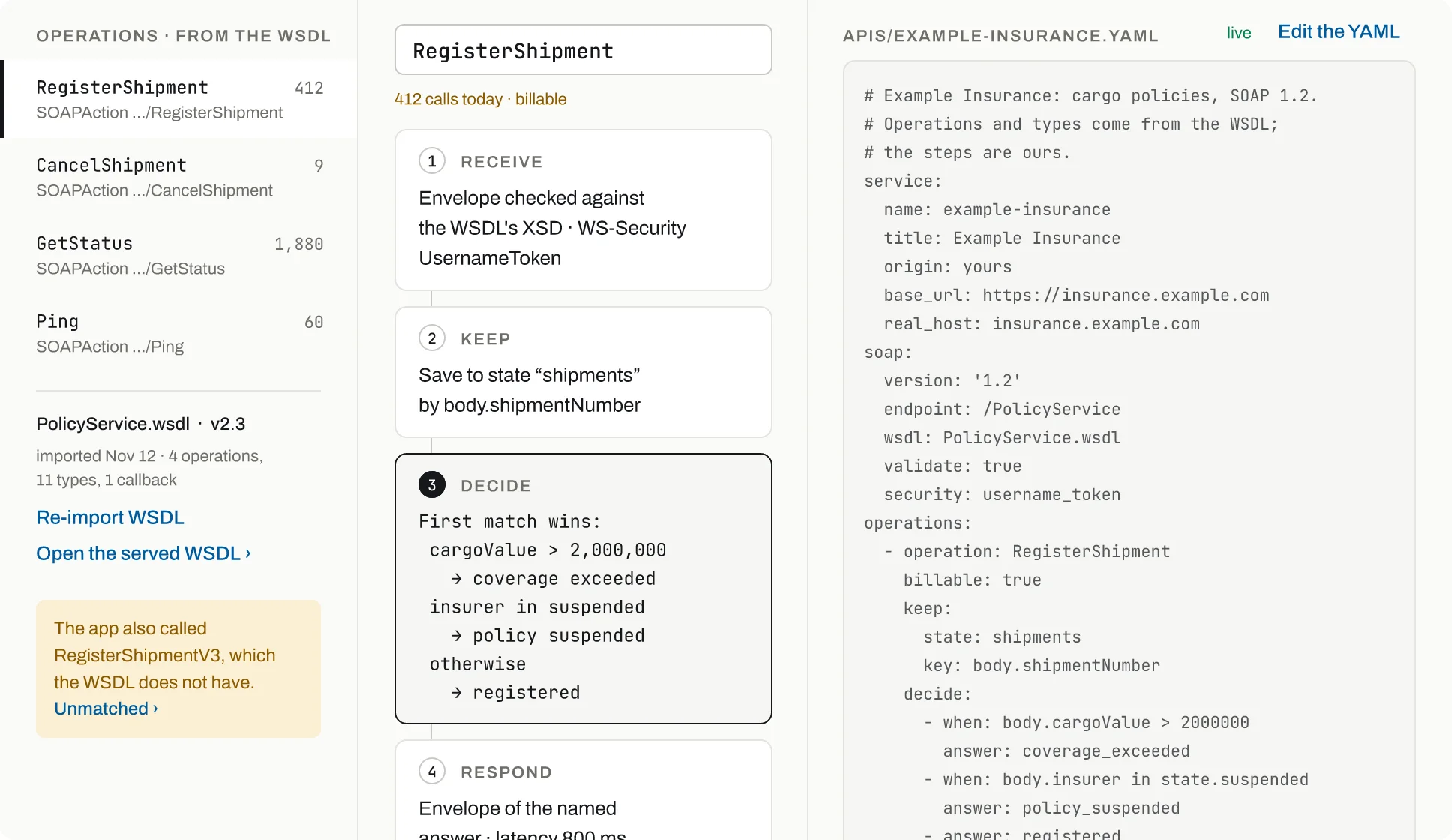
Each with its SOAPAction and calls today; the request and response types come from the WSDL.
The envelope is checked against the WSDL's XSD and the WS-Security UsernameToken.
First match wins: a cargo value over the limit gets the coverage_exceeded fault.
Reads a new WSDL and keeps your steps; the served WSDL is one click away.
A call for an operation the WSDL does not have gets a Sender fault and shows in Unmatched.
- One per WSDL operation
Each with its SOAPAction and calls today; the request and response types come from the WSDL.
- Receive
The envelope is checked against the WSDL's XSD and the WS-Security UsernameToken.
- Decide
First match wins: a cargo value over the limit gets the coverage_exceeded fault.
- Re-import WSDL
Reads a new WSDL and keeps your steps; the served WSDL is one click away.
- Operation it lacks
A call for an operation the WSDL does not have gets a Sender fault and shows in Unmatched.
A fault is a named answer
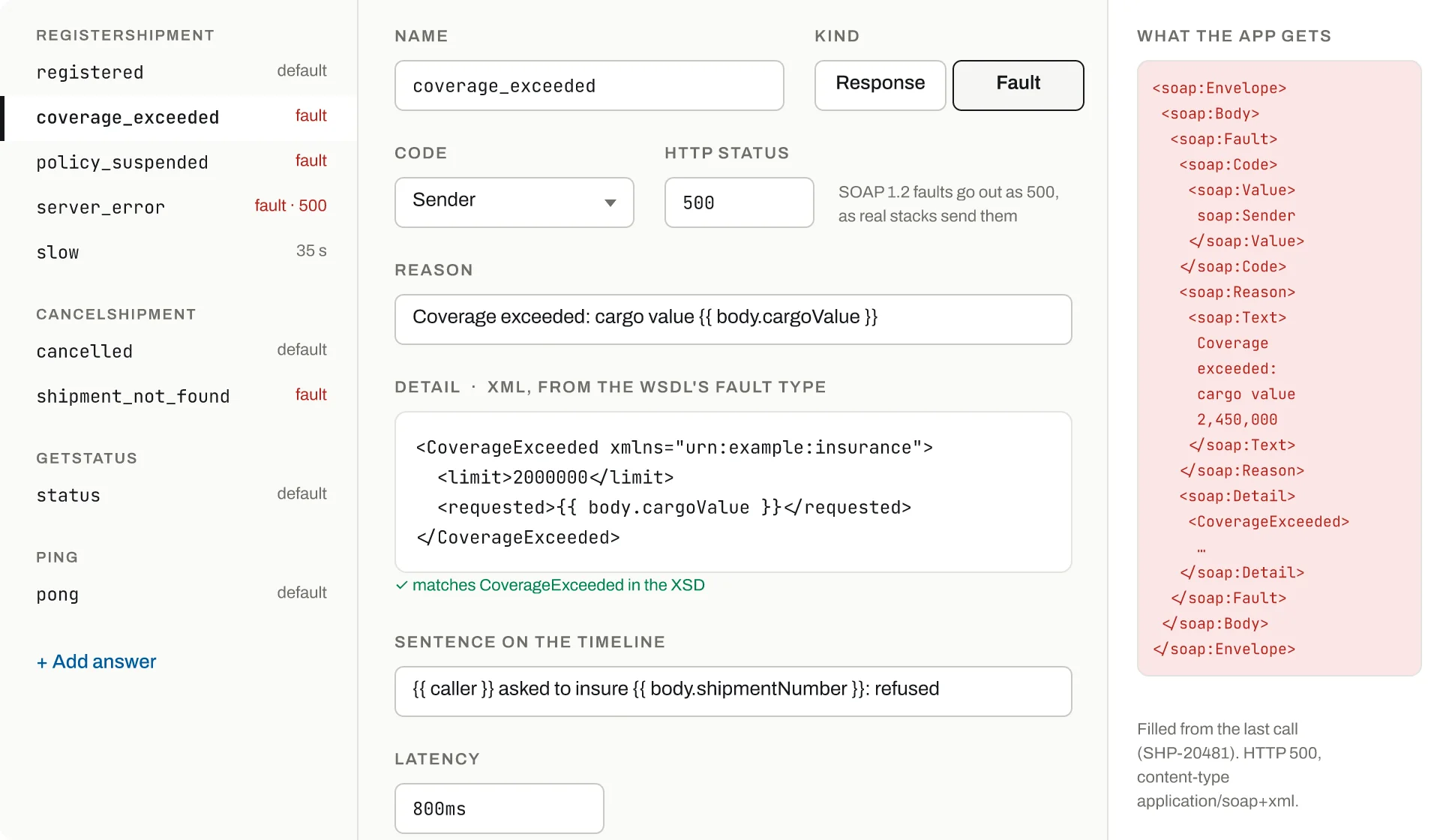
Declared faults arrive as answers, next to each operation's default response.
The same answer editor; Fault adds code, reason and detail.
Sender or Receiver (Client and Server for SOAP 1.1), sent with HTTP 500 unless you set another.
The fault's detail element is a template, checked against the WSDL's fault type.
The whole envelope in the call's SOAP version, filled from the last call.
- Faults from the WSDL
Declared faults arrive as answers, next to each operation's default response.
- Response or Fault
The same answer editor; Fault adds code, reason and detail.
- Code and status
Sender or Receiver (Client and Server for SOAP 1.1), sent with HTTP 500 unless you set another.
- Detail from the XSD
The fault's detail element is a template, checked against the WSDL's fault type.
- What the app gets
The whole envelope in the call's SOAP version, filled from the last call.
mTLS, ICP certificates and XML signatures
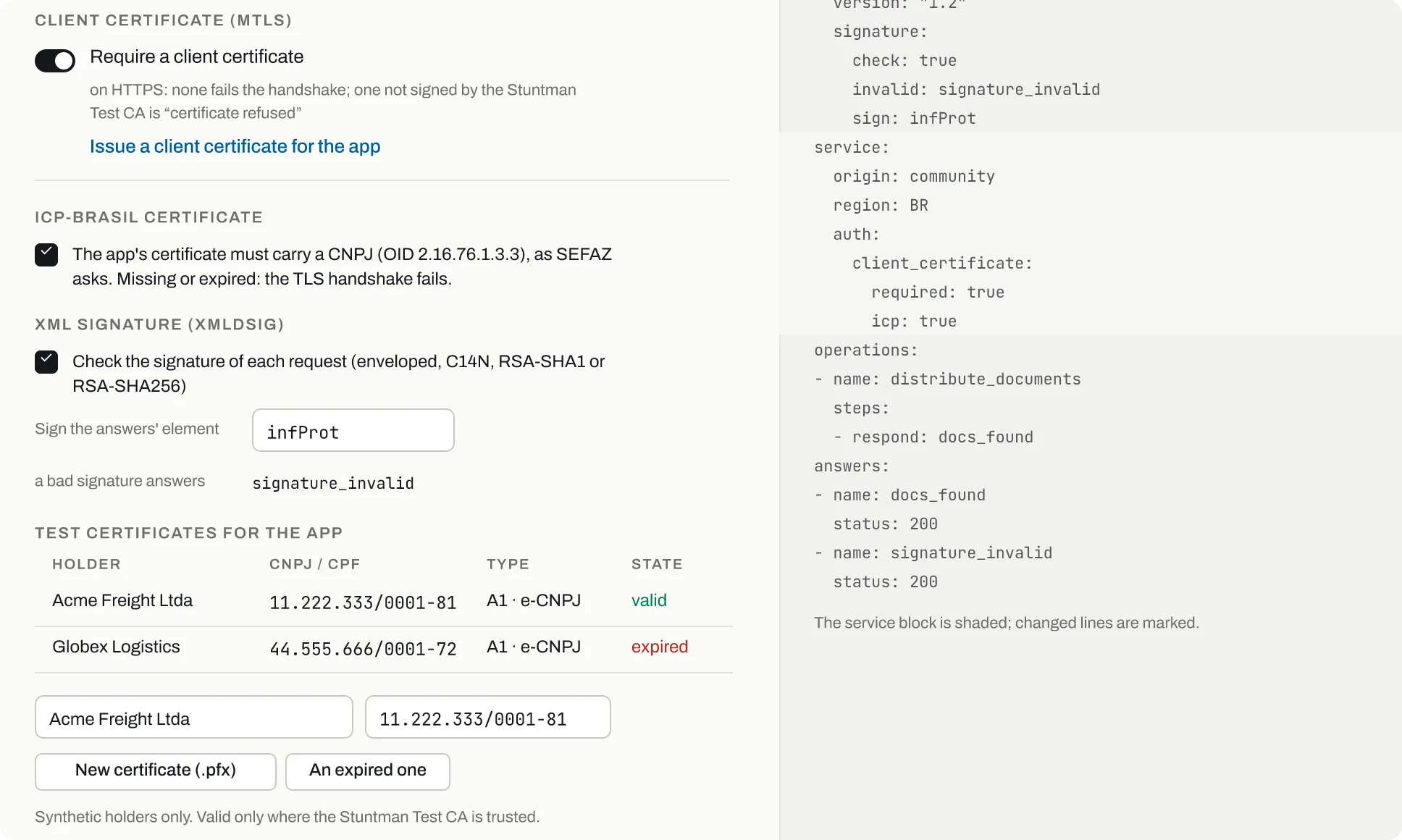
On HTTPS a missing certificate fails the handshake; one not signed by the Test CA is refused.
ICP-Brasil style: the certificate needs OID 2.16.76.1.3.3. An e-CPF or an expired one fails.
A tampered or unsigned document gets the signature_invalid answer, or a Sender fault.
The named element of each answer is signed with the service's own certificate. Faults are not signed.
Synthetic e-CNPJ or e-CPF as .pfx and PEM; ask for an expired or untrusted one on purpose.
- Require a client certificate
On HTTPS a missing certificate fails the handshake; one not signed by the Test CA is refused.
- Must carry a CNPJ
ICP-Brasil style: the certificate needs OID 2.16.76.1.3.3. An e-CPF or an expired one fails.
- Check each request's signature
A tampered or unsigned document gets the signature_invalid answer, or a Sender fault.
- Sign the answers
The named element of each answer is signed with the service's own certificate. Faults are not signed.
- Test certificates
Synthetic e-CNPJ or e-CPF as .pfx and PEM; ask for an expired or untrusted one on purpose.
Break it on purpose
The failures you need to test, exactly when you ask: from the screen or by a tool call, each one shown on the timeline with who caused it.
A declared faultAny fault the WSDL declares, on the next calls
force_answer coverage_exceeded, or a decide ruleA fault it does not declareA new fault with your code, reason and detail
set_answer fault={code, reason}Validation faultA body that breaks the XSD gets the provider's Sender fault naming the field
send a bad body, or tighten typesVersionMismatchA SOAP 1.1 envelope sent to a 1.2 service, or the reverse
soap.version in the pluginRefused credentialsThe security token could not be authenticated or authorized
security: username_token and a wrong passwordRefused XML signatureA missing, broken or tampered ds:Signature
set_service xml_signature_checkRefused client certificateNo certificate, an e-CPF, an expired or an untrusted one fails the handshake
set_service client_certificate_icp + new_test_certificateServer fault500 goes out as a Receiver fault
force_answer 500Slow or droppedLatency, reset, empty, timeout, 503 or an HTML page
force_answer, set_service latencyUnknown operationA SOAPAction the WSDL lacks gets a Sender fault and lands in Unmatched
call it; list_unmatched
Why not the real sandbox
No provider copy needed
The WSDL is enough: no recording, no running SOAP stack, no VPN to a homologation server.
Every fault on demand
Faults that a test environment almost never returns come on the next call, then stop.
Certificates without paperwork
Synthetic e-CNPJ and e-CPF test certificates in one call, valid, expired or untrusted.
Envelopes you can read
Each call shows the operation picked, the checks it passed and the raw envelopes in and out.
Your AI agent drives it
Claude Code, Codex or any MCP client connects to /mcp (or calls /api over plain HTTP), sets the stand-in up, breaks it on cue and reads what your app did.
Stand in for the insurer's SOAP service from its WSDL and check how we handle the coverage fault.
MCP tools
import_wsdlA SOAP service from a WSDL (URL, file or text)reimport_wsdlReads the WSDL again and keeps your stepslist_operationsOperations, SOAPActions and the served WSDL's URLset_operationReplaces an operation's stepstry_operationRuns an envelope through the service; nothing is keptsend_callbackCalls the app's endpoint as the provider wouldset_answerWith fault, makes an answer a SOAP faultnew_test_certificateAn ICP-Brasil style e-CNPJ or e-CPF test certificatesign_xmlSigns an element of an XML documentverify_xml_signatureChecks every ds:Signature of a document
The same over HTTP
- POST
/api/plugins/wsdl - GET
/api/plugins/{service}/operations - POST
/api/plugins/{service}/operations/try - POST
/api/plugins/{service}/callback - POST
/api/apis/test-certificates - POST
/api/apis/xml/sign
- WSDL 1.1 document/literal only: no WSDL 2.0, RPC/encoded or MTOM.
- WS-Security covers UsernameToken with a plain-text password, not WS-Security signatures, encryption or timestamps.