Everything Identity gives you
- 01
Four flavours of OIDC
Entra ID v2, Google, Okta or generic OIDC: discovery, JWKS, authorize, token, userinfo and logout, with the provider's error codes.
- 02
A sign-in page
Stuntman serves the login page: a person, a test or an agent picks the simulated user, then MFA and consent follow.
- 03
Synthetic people
Users with tenant, groups, roles, MFA, guest, extra claims, locked or disabled. The next tokens carry the change.
- 04
App registrations
Web, SPA, daemon or API apps with exact redirect URIs, secrets, permissions, optional claims and admin consent.
- 05
SAML 2.0 IdP
Metadata, SSO by Redirect or POST, a signed assertion posted to the app's ACS; name ID from email, oid or upn.
- 06
LDAP directory
Simple bind, search, compare and whoami on :3389. Wrong passwords, locked and disabled accounts answer as Active Directory.
- 07
Password grant
grant_type=password with AADSTS50126 for a wrong password, AADSTS50076 for MFA and AADSTS50053 for a locked user.
- 08
Bot Framework
send_bot_activity posts a Teams message or card action to the bot, signed by the Bot Connector; replies land in list_bot_messages.
- 09
OAuth client checks
Stuntman acts as the client of the app's MCP server and runs ten authorization checks against it.
The screens
Each number is a control or a reading on the real screen. Everything you can click there, your agent can do with a tool.
The sign-in page Stuntman serves
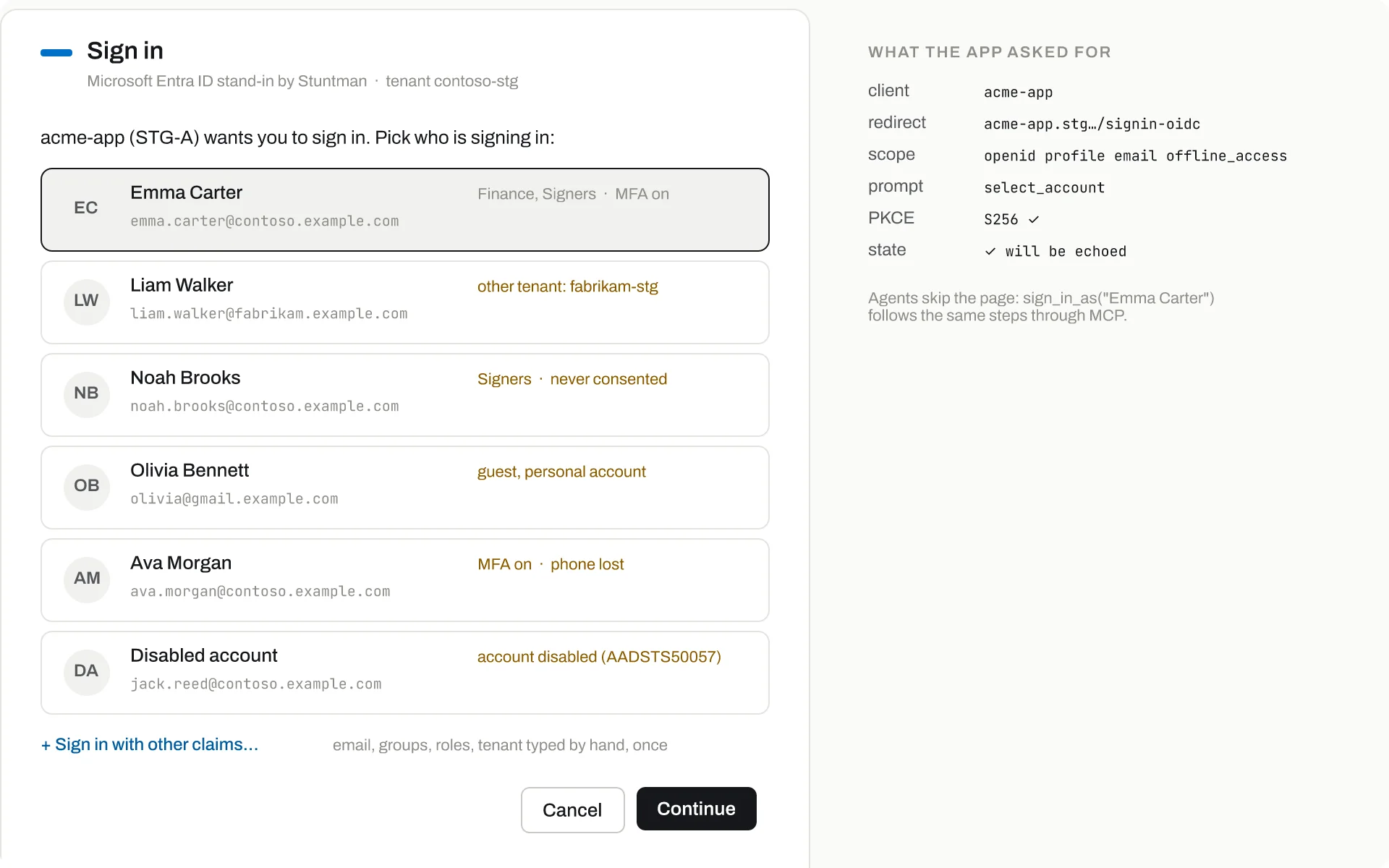
Each synthetic user with groups and MFA. Agents skip the page with sign_in_as.
A user from another tenant, for apps that must refuse or accept guests.
A user whose MFA cannot complete, to test the app's error page.
Client, redirect, scopes, prompt, PKCE and state, checked against the app registration.
The person cancels: the app gets error=access_denied.
- Pick who signs in
Each synthetic user with groups and MFA. Agents skip the page with sign_in_as.
- Another tenant
A user from another tenant, for apps that must refuse or accept guests.
- MFA, phone lost
A user whose MFA cannot complete, to test the app's error page.
- What the app asked for
Client, redirect, scopes, prompt, PKCE and state, checked against the app registration.
- Cancel
The person cancels: the app gets error=access_denied.
Users and the claims they carry
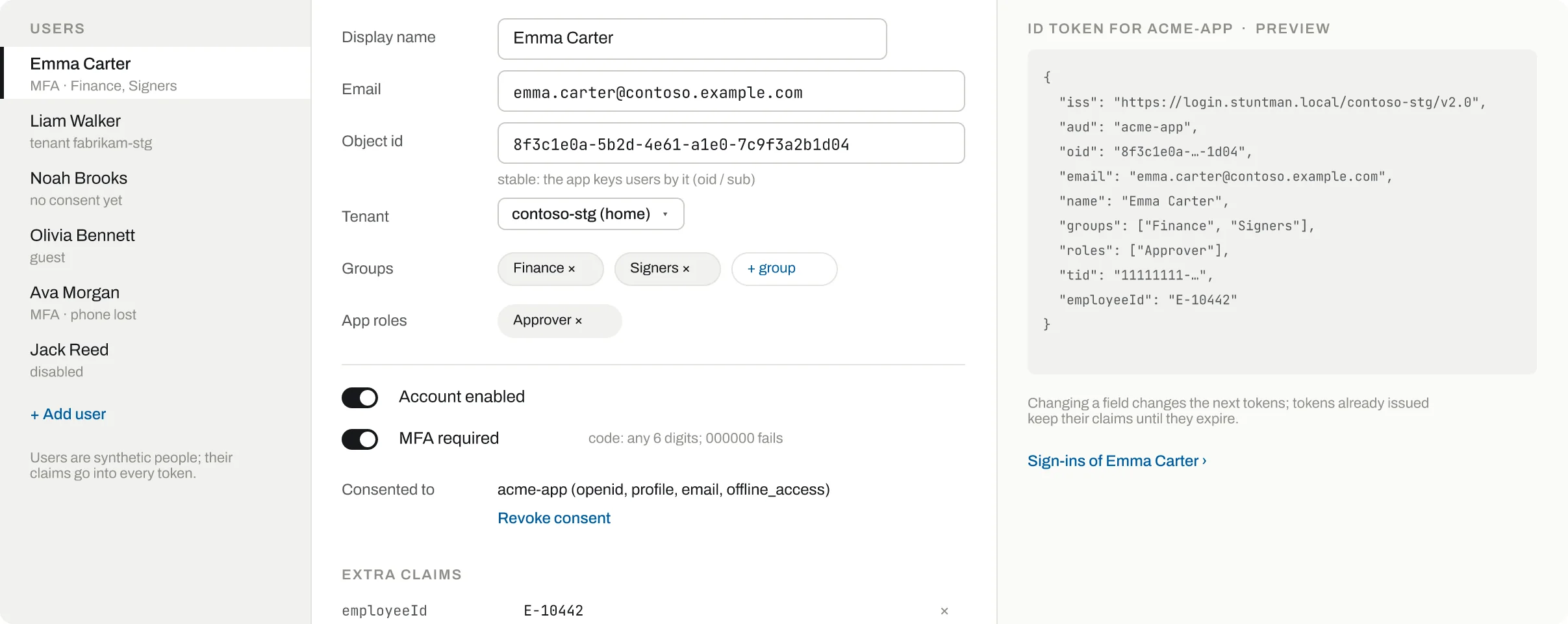
Synthetic people of the tenant: MFA, guest, another tenant, disabled.
Set groups or a number of them: 210 groups takes the app down the overage path.
The next sign-in asks for a code; provoke mfa_fails to make it fail.
The ID token the app will get, with the claims of this user.
The next sign-in asks again and refresh tokens stop working.
- Users
Synthetic people of the tenant: MFA, guest, another tenant, disabled.
- Groups and roles
Set groups or a number of them: 210 groups takes the app down the overage path.
- MFA required
The next sign-in asks for a code; provoke mfa_fails to make it fail.
- The token
The ID token the app will get, with the claims of this user.
- Revoke consent
The next sign-in asks again and refresh tokens stop working.
Older protocols on the same users
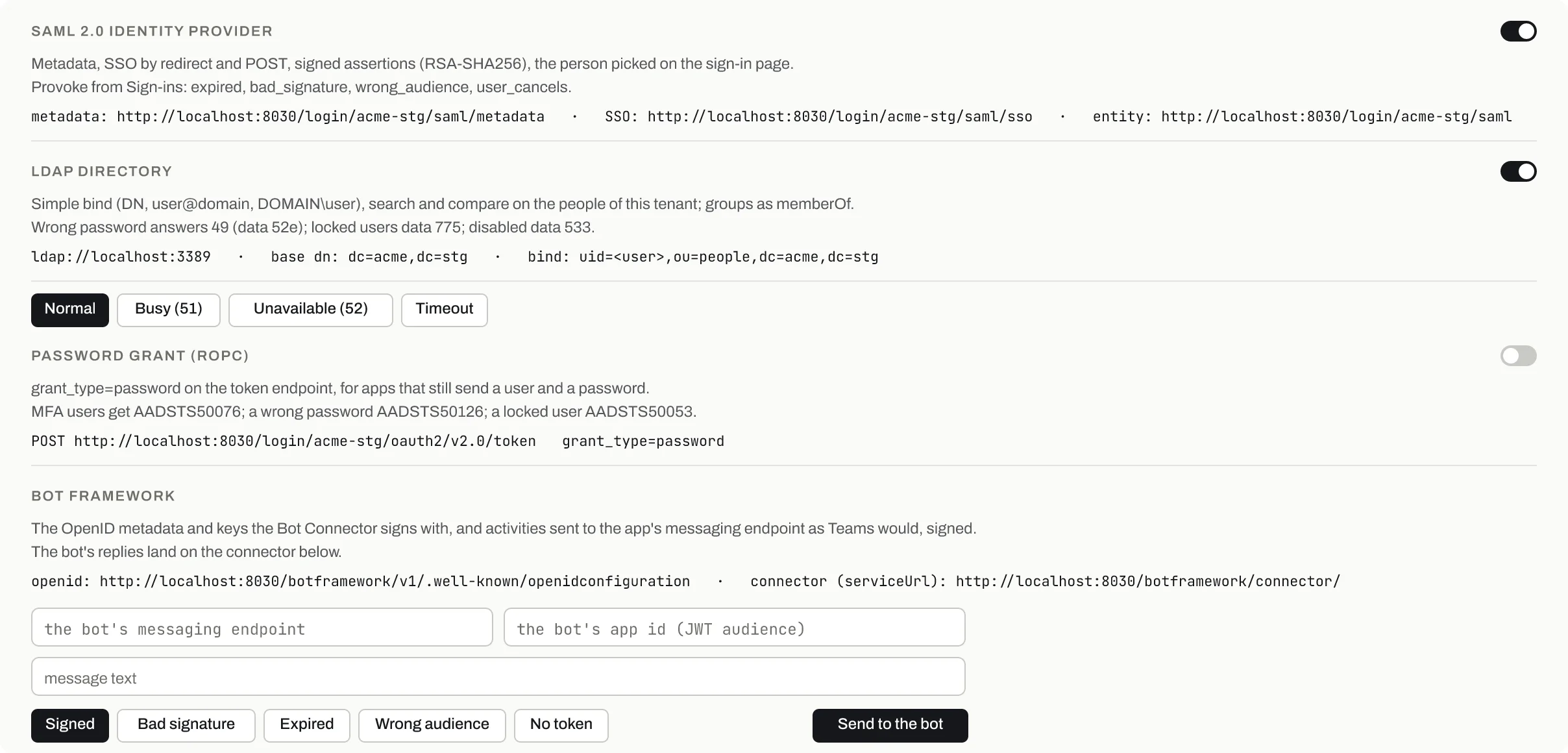
Metadata, SSO and entity ID per tenant, with signed assertions (RSA-SHA256).
busy (51), unavailable (52) or timeout; normal stops it.
Off by default; on, it answers with the provider's AADSTS errors.
Send an activity with a bad signature, expired, wrong audience or no token.
Posts the activity to the bot's endpoint as Teams would, signed by the connector.
- SAML 2.0
Metadata, SSO and entity ID per tenant, with signed assertions (RSA-SHA256).
- LDAP provocations
busy (51), unavailable (52) or timeout; normal stops it.
- Password grant
Off by default; on, it answers with the provider's AADSTS errors.
- Bot twists
Send an activity with a bad signature, expired, wrong audience or no token.
- Send to the bot
Posts the activity to the bot's endpoint as Teams would, signed by the connector.
Break it on purpose
The failures you need to test, exactly when you ask: from the screen or by a tool call, each one shown on the timeline with who caused it.
MFA required or failingThe next sign-ins ask for MFA, or the code fails
provoke_sign_in mfa_required | mfa_failsConsent requiredThe user must consent again
provoke_sign_in consent_requiredUser cancelsThe app gets error=access_denied
provoke_sign_in user_cancels or cancel_loginWrong tenantA user from another tenant signs in
provoke_sign_in wrong_tenantExpired tokensTokens arrive already expired
provoke_sign_in expiredBad signatureTokens or SAML assertions signed wrongly
provoke_sign_in bad_signatureIdP downThe sign-in fails because the provider is down
provoke_sign_in idp_downDiscovery or JWKS brokenDiscovery 500, wrong issuer, kid missing, token invalid_grant
provoke_idpSigning key rotatedApps that cached the JWKS at start-up reject new tokens
rotate_signing_keyDisabled userSign-ins stop with AADSTS50057; refresh tokens refused
set_user_stateLDAP busyBinds answer 51, 52 or time out
set_provider ldap_provokeBad bot activitybad_signature, expired, wrong_audience, no_token
send_bot_activity twist
Why not the real sandbox
No test tenant to manage
No Entra, Google or Okta tenant, no test accounts with real MFA, no admin to grant consent. Users are synthetic and made in one call.
Every edge case on demand
Expired tokens, rotated keys, group overage and cancelled logins, which a real tenant almost never shows you.
Agents can sign in
sign_in_as completes the login, MFA and consent, so a coding agent tests flows behind SSO without a person.
One directory, every protocol
OIDC, SAML, LDAP and the password grant answer for the same people, so legacy and new code paths are tested together.
Your AI agent drives it
Claude Code, Codex or any MCP client connects to /mcp (or calls /api over plain HTTP), sets the stand-in up, breaks it on cue and reads what your app did.
Check that the app handles an Entra key rotation without logging everyone out.
MCP tools
set_providerCreate a provider: flavour, tenant, SAML, LDAP, password grantset_userCreate or change a synthetic user and its claimsset_appRegister an app: type, redirect URIs, secret, permissionssign_in_asComplete the login page as a user, through MFA and consentprovoke_sign_inMake the next sign-ins failprovoke_idpBreak discovery, JWKS or the token endpointrotate_signing_keyRotate the token signing keylist_sign_insSign-ins and tokens, with AADSTS codessend_bot_activitySend the bot a Teams activity, signedlist_bot_messagesBoth sides of the bot conversation
The same over HTTP
- PUT
/api/identity/providers/{name} - PUT
/api/identity/{provider}/users/{user} - POST
/api/identity/{provider}/sign-in-as - POST
/api/identity/{provider}/provoke - POST
/api/identity/{provider}/keys/rotate - GET
/api/identity/sign-ins
- LDAP uses one port for every environment: binds go to the default one.