Everything Secrets gives you
- 01
Secrets with versions
Synthetic values with versions, expiry, content type and tags. A new version sends SecretNewVersionCreated to subscribers.
- 02
Keys that really sign
RSA 2048, 3072 or 4096 keys that sign, verify, wrap and unwrap, so the app's crypto code runs for real.
- 03
Certificates from a Test CA
Issue, import (.pfx or PEM) and renew certificates; each shows subject, issuer, validity and days left.
- 04
Who reads what
Reads per process and per identity. A secret read on every request shows up at once: the app is not caching it.
- 05
An access log
Every operation with identity, item and answer, kept 24 h, and vault_patterns lists what looks wrong.
- 06
Managed identity
The IMDS token endpoint hands tokens to identities with roles and name scopes, like Key Vault RBAC.
- 07
What a real vault refuses
With any_token on, would_fail lists the operations a real vault would have refused for that identity.
- 08
Soft delete and recover
Deleted items stay soft-deleted: recreating the name gets 409 until recover_item.
- 09
Find every reference
secret_used_by lists the environment files that point at secret://<name>, even before the secret exists.
The screens
Each number is a control or a reading on the real screen. Everything you can click there, your agent can do with a tool.
Secrets, versions and readers
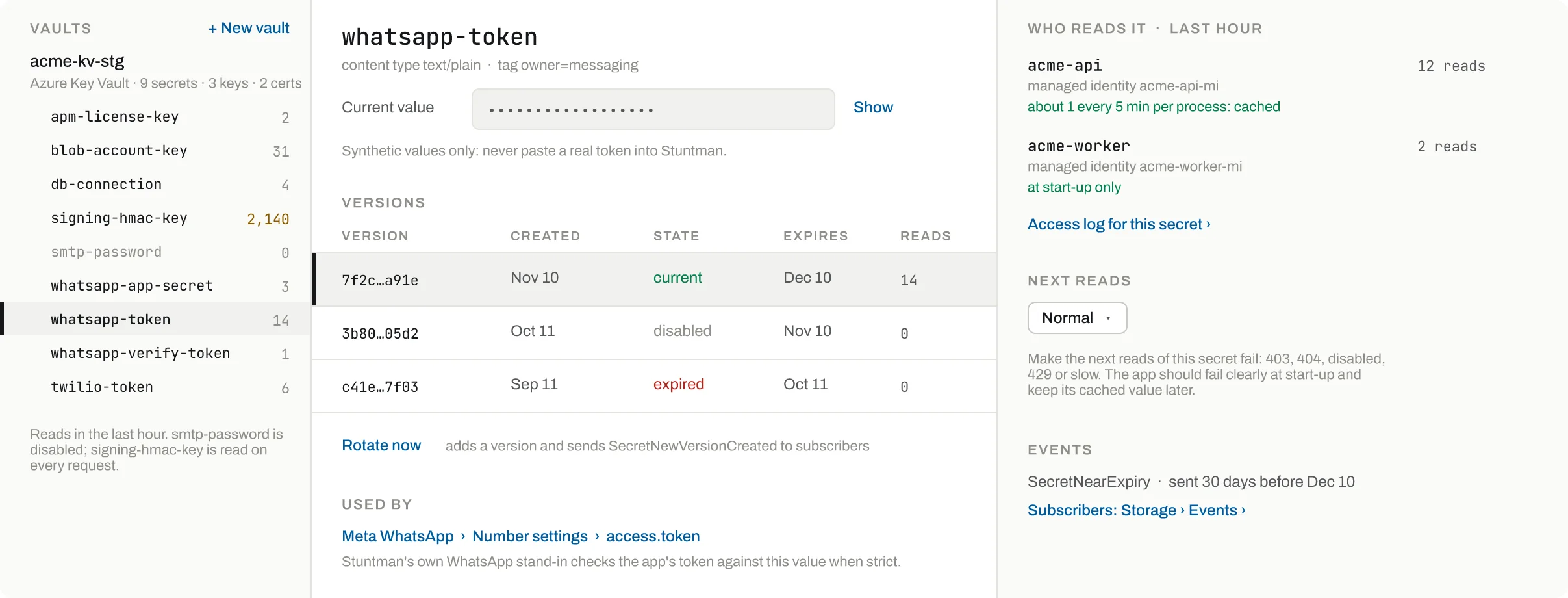
Reads in the last hour per secret; a big number means the app reads it on every request.
Current, disabled or expired versions, each with its own read count.
Each process and identity, and whether it looks cached.
Make the next reads fail: 403, 404, disabled, 429 or slow.
A new version and SecretNewVersionCreated to subscribers.
- Read 2,140 times
Reads in the last hour per secret; a big number means the app reads it on every request.
- Versions
Current, disabled or expired versions, each with its own read count.
- Who reads it
Each process and identity, and whether it looks cached.
- Next reads
Make the next reads fail: 403, 404, disabled, 429 or slow.
- Rotate
A new version and SecretNewVersionCreated to subscribers.
The access log
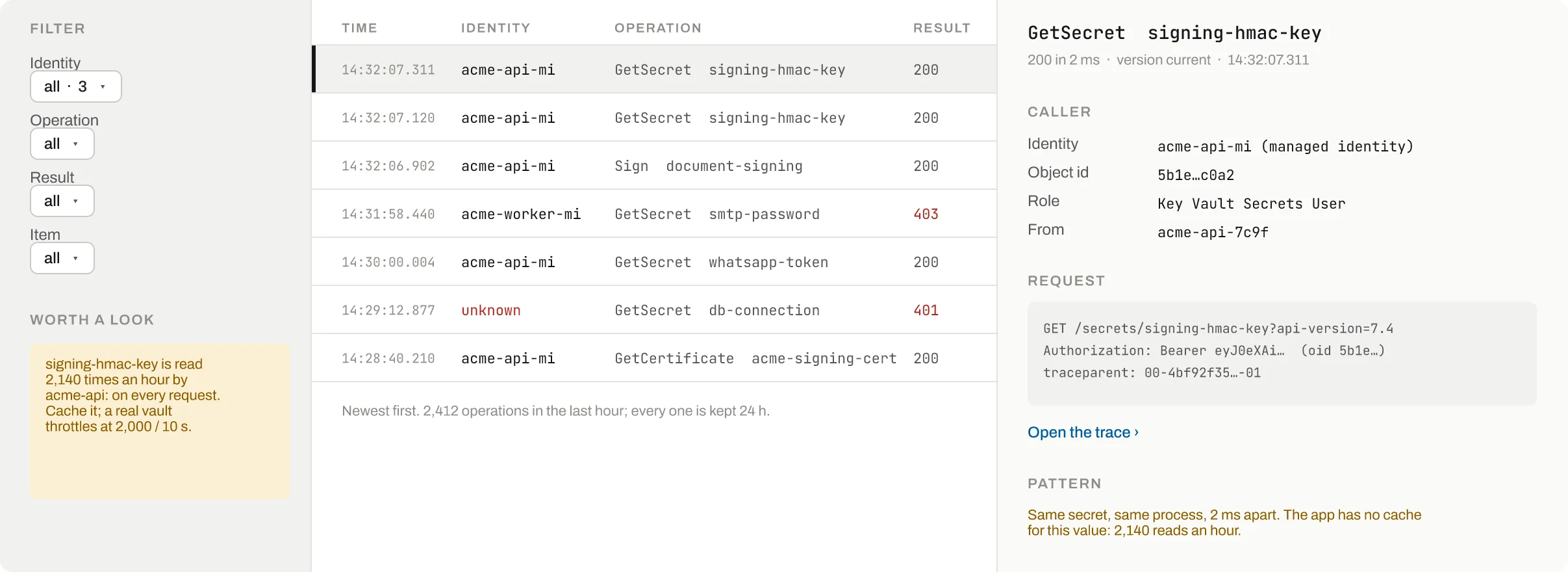
A pattern found in the log: a secret read on every request, which a real vault would throttle.
403 for an identity without the role for this item.
A request with no known identity gets 401, and is listed.
Identity, object id and role of the token that made the call.
Same secret, same process, 2 ms apart: the app has no cache.
- Worth a look
A pattern found in the log: a secret read on every request, which a real vault would throttle.
- Refused
403 for an identity without the role for this item.
- Unknown caller
A request with no known identity gets 401, and is listed.
- The caller
Identity, object id and role of the token that made the call.
- Pattern
Same secret, same process, 2 ms apart: the app has no cache.
Keys that really sign
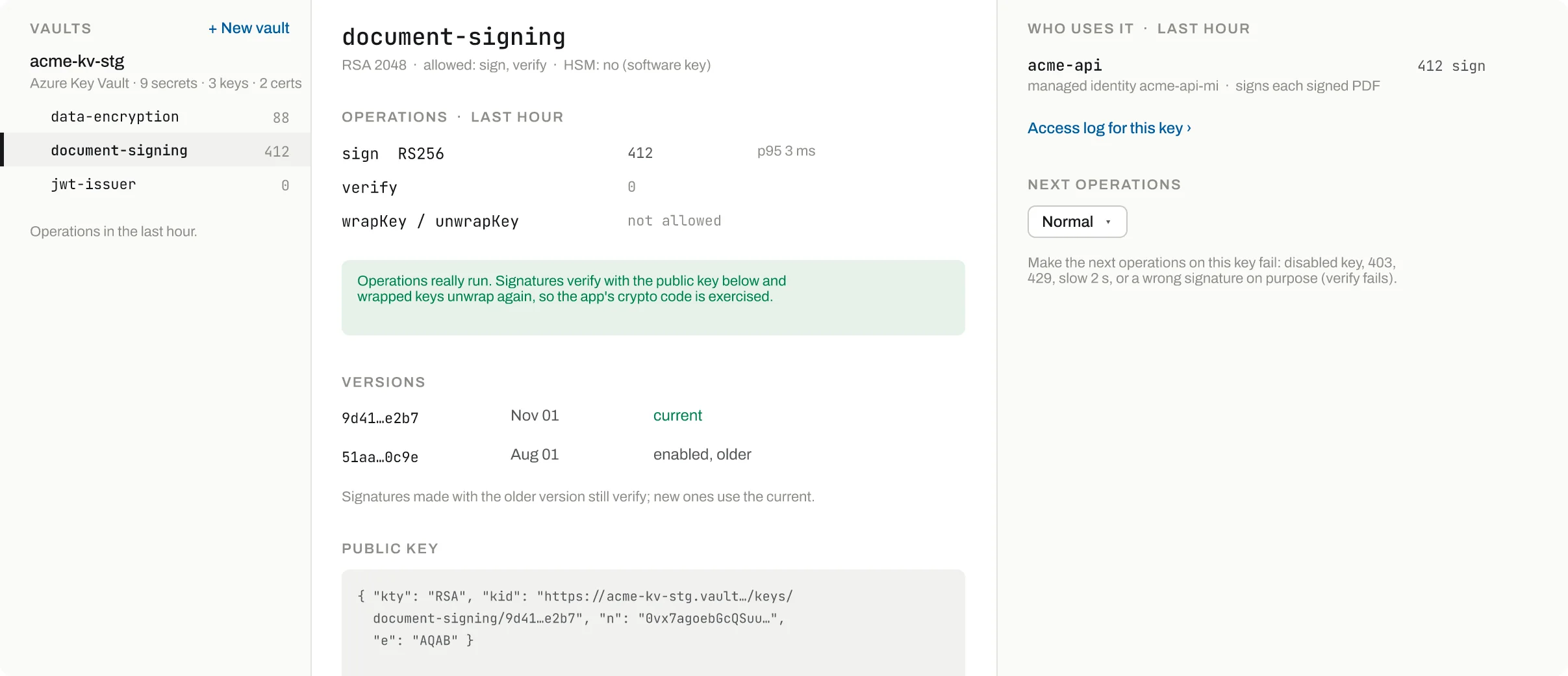
Sign, verify, wrap and unwrap in the last hour, with p95.
Signatures verify with the public key; wrapped keys unwrap again.
Disabled, 403, 429, slow, or a wrong signature that fails verify.
Rotation adds a version; signatures from the older one still verify.
As JWK or PEM, to verify outside the app.
- Operations
Sign, verify, wrap and unwrap in the last hour, with p95.
- Real crypto
Signatures verify with the public key; wrapped keys unwrap again.
- Next operations
Disabled, 403, 429, slow, or a wrong signature that fails verify.
- Versions
Rotation adds a version; signatures from the older one still verify.
- Public key
As JWK or PEM, to verify outside the app.
Break it on purpose
The failures you need to test, exactly when you ask: from the screen or by a tool call, each one shown on the timeline with who caused it.
Secret refusedNext reads answer 403 or 404
provoke_secret 403 | 404Secret disabledReads answer as for a disabled secret
provoke_secret disabled or set_secret_stateThrottledReads answer 429
provoke_secret 429Slow vaultReads take 3 s
provoke_secret slowWrong signaturesign returns a signature that fails verify
provoke_key wrong_signatureKey disabledKey operations fail
provoke_key disabledCertificate expiredExpired, not yet valid, missing or untrusted
provoke_certificateWrong .pfx passwordThe certificate's .pfx does not open
provoke_certificate wrong_passwordIMDS failsThe token endpoint answers 500, slow or no identity
provoke_imdsSoft-deleted nameRecreating a deleted secret gets 409
delete_secret
Why not the real sandbox
No real values
Values are synthetic, so tests and agents never touch a production secret or a cloud subscription.
Caching made visible
Read counts per process prove whether the app caches secrets, which the real vault only shows as throttling later.
Failures on request
Expired certificates, wrong signatures and a broken IMDS happen on the next call, not on the day they expire.
Real crypto, no HSM
Keys really sign and wrap, so signing code is tested end to end without a vault in Azure.
Your AI agent drives it
Claude Code, Codex or any MCP client connects to /mcp (or calls /api over plain HTTP), sets the stand-in up, breaks it on cue and reads what your app did.
Find out whether the app caches the HMAC signing secret or reads it on every request.
MCP tools
list_secretsSecrets with version, state, expiry and readsset_secretA new version of a synthetic secretsecret_readsWho read a secret and whether it looks cachedprovoke_secretMake the next reads failprovoke_keyMake key operations fail or sign wronglyprovoke_certificateMissing, expired or untrusted certificatesprovoke_imdsBreak the managed identity endpointvault_logEvery operation, newest firstvault_patternsFindings in the access logwould_failWhat a real vault would have refused
The same over HTTP
- GET
/api/keyvault/secrets - GET
/api/keyvault/secrets/{name}/reads - POST
/api/keyvault/secrets/{name}/provoke - POST
/api/keyvault/keys/{name}/provoke - POST
/api/keyvault/imds/provoke - GET
/api/keyvault/log
- The vault is found by host name: give each environment a base domain under a wildcard DNS name.